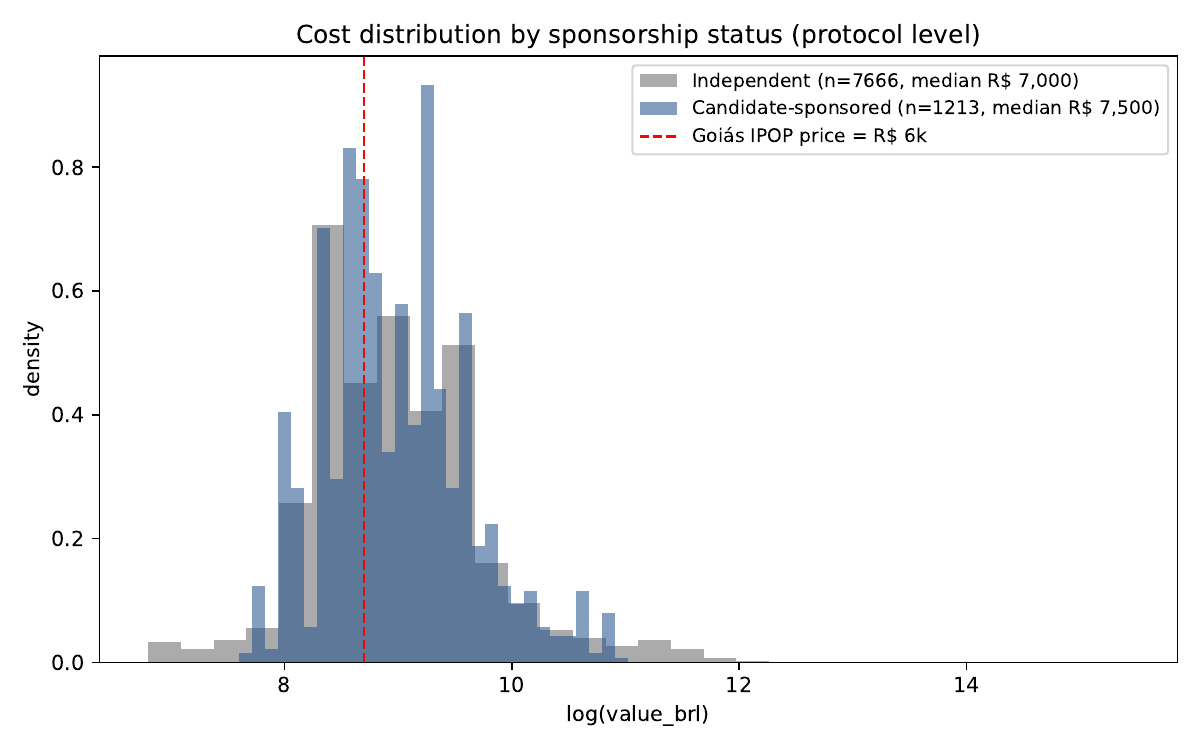
Candidate-sponsored polls cost +13.78 log-points more than independent polls within firm × race (Spec 1, n=8,879 protocols, SE 0.030, p < 1e-6) — a ~15 % premium on the universe median R$ 7,500. But the firm-level premium does NOT correlate with within-firm β (Spec 2: r = −0.032, n=21), and the cost × bias interaction within sponsored polls is essentially zero (Spec 3: sp × log_cost_z β = −0.35 pp, SE 1.26, p = 0.78). The +15 % premium is real but does not behave like a slant menu-price: no firm-level heterogeneity, no within-poll dose-response. Most plausibly it's a production-cost premium (shorter timeline, additional deliverables, contract structure). The Goiás IPOP menu-pricing reading does not generalize at universe scale; if M4 slant payments exist, they are off-book and not reflected in VR_PESQUISA. Sanity check: the Goiás IPOP R$ 6k rate is BELOW the universe median R$ 7,500 — IPOP's slant-included price sits at the cheap end, consistent with low-production-cost firms internalizing the slant rather than charging a premium for it.
Question
The enforcement-puzzle doc anchors the Goiás IPOP case as
existence proof for menu pricing of slant: charged ≈ R$ 6,000
per "first-place" poll across 191 municipalities. AN-079 tests
whether menu pricing is observable at universe scale via the
declared cost in the TSE registry (VR_PESQUISA /
poll_2024.value_brl):
- (1) Within firm and within race, do candidate-sponsored polls cost more than independent polls?
- (2) Do firms that charge a sponsorship cost premium have larger within-firm β (AN-016)?
- (3) Within candidate-sponsored polls, does higher cost correlate with larger error?
Design
source/analysis/an-079-cost-by-sponsor.py:
- Load
cand_poll.parquet(analysis sample), joinvalue_brlfrompoll_response_2024.parquetper protocol. - Spec 1. Protocol-level regression (dedupe to protocol):
`log(value_brl) ~ poll_has_candidate_sponsor + log_sample_size
- days_to_election + days_to_election_sq | institute FE + muni_id FE, cluster=muni_id`.
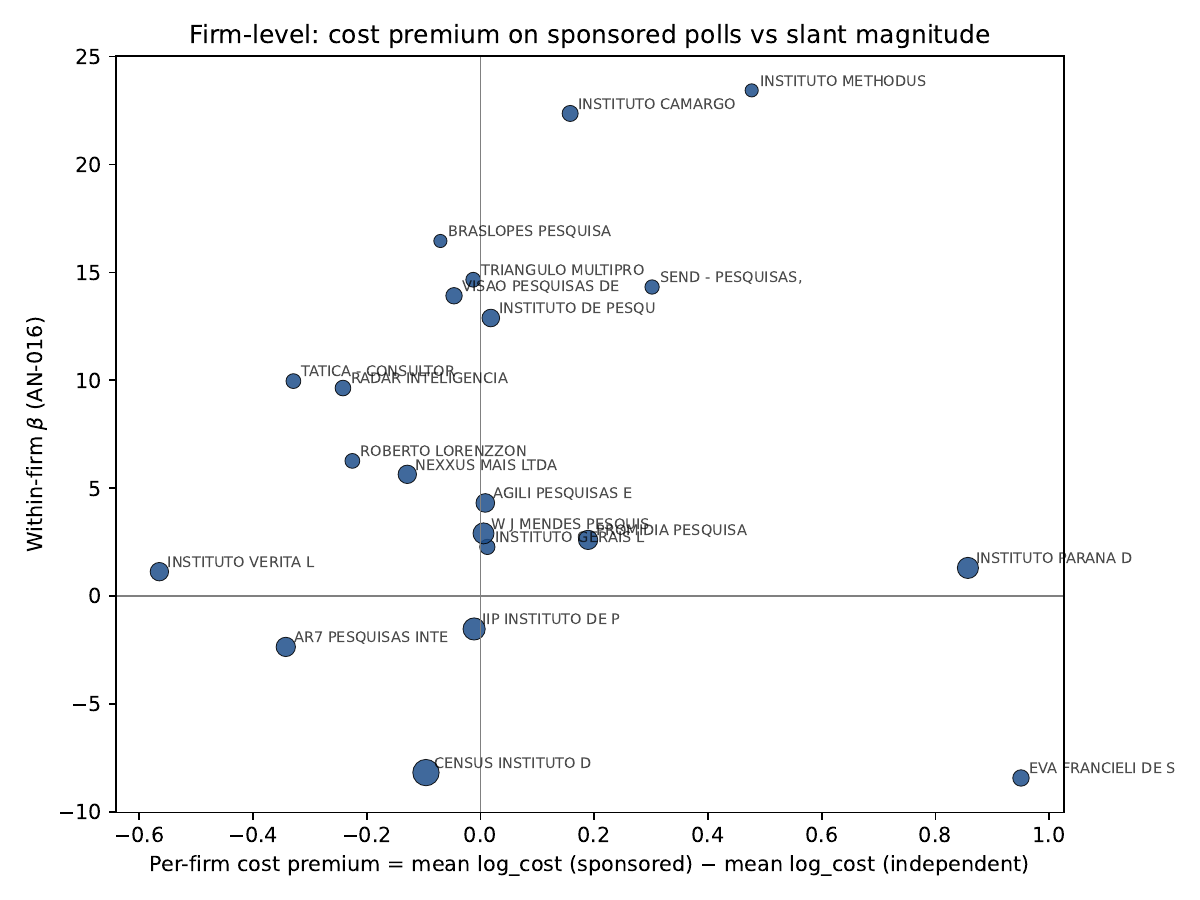
- Spec 2. Per-firm cost premium: for each firm in AN-016 (n=22), compute mean log_cost on candidate-sponsored protocols vs independent protocols. Scatter premium × within-firm β.
- Spec 3.
error ~ sponsored_by + sponsored_by:log_cost_z + opponent_sponsored + log_sample_size + days_to_election + days_to_election_sq | candidate FE + institute FE, cluster=muni_id, where log_cost_z is the z-scored log cost across the cand_poll sample.
Results
Spec 1 — Within firm × race, sponsored polls cost more
| Coefficient | β (log points) | SE | p |
|---|---|---|---|
| poll_has_candidate_sponsor | +0.1378 | 0.0302 | < 1e−6 |
| log_sample_size | +0.3671 | 0.0461 | < 1e−15 |
| days_to_election | −0.0004 | 0.0004 | 0.30 |
| days_to_election_sq | +0.0000 | 0.0000 | 0.37 |
n = 8,879 protocols (1,213 sponsored, 7,666 independent). Within institute FE + muni FE, candidate-sponsored polls cost exp(0.1378) − 1 ≈ 14.8 % more than comparable independent polls of similar sample size and timing. Highly precise.
Spec 2 — Firm-level premium does not predict slant
- Firms with both ≥ 1 sponsored and ≥ 1 independent poll: 207.
- Mean firm-level log-cost premium: +0.043 (median +0.008, sd 0.34). Firm-level dispersion is large.
- Cross-cut with AN-016 β (n = 21 firms with usable β): Pearson r(premium_log_cost, β) = −0.032 — essentially zero.
The +15 % universe-average premium does not concentrate in firms with larger slant. Firms aren't pricing slant heterogeneously.
Spec 3 — Within sponsored polls, cost does not predict bias
| Coefficient | β (pp) | SE | p |
|---|---|---|---|
| sponsored_by | +7.33 | 1.39 | < 1e−6 |
| sponsored_by × log_cost_z | −0.35 | 1.26 | 0.78 |
| opponent_sponsored | −2.28 | 0.74 | 0.002 |
| log_sample_size | +0.02 | 0.49 | 0.97 |
| days_to_election | −0.04 | 0.01 | 0.006 |
| days_to_election_sq | +0.0002 | 0.0001 | 0.001 |
The interaction is the load-bearing test: a +1 sd increase in log cost on a sponsored poll shifts β by −0.35 pp (CI [−2.8, +2.1]). Higher-cost sponsored polls slant the same as lower-cost sponsored polls within candidate FE + institute FE. The Spec 1 cost premium does not carry slant per peso.
Sanity-check against Goiás IPOP
The IPOP "first-place" menu price was R$ 6,000 — the existence proof for menu-pricing of slant in the enforcement-puzzle doc. The universe median for value_brl is R$ 7,500. IPOP's slant-included rate sits at the 25th percentile of the universe cost distribution, not above it. This is consistent with the joint pattern of Specs 1–3: the slant doesn't carry a price premium; it comes free with cheap production at small specialist firms. IPOP wasn't charging extra for slant; it was charging LESS than the median for slanted polls, internalizing the slant into a low-cost production stream.
Interpretation
The +15 % within-firm × within-race sponsorship cost premium is real and precise but does not behave like a slant menu-price:
- Firms charging the highest premium are not the firms with the highest within-firm β (Spec 2: r = −0.03, n = 21).
- Within sponsored polls, higher cost does not predict larger error (Spec 3: interaction p = 0.78).
- The Goiás IPOP existence-proof price sits BELOW the universe median, refuting the "menu price = premium" implication.
The most plausible reading of the +15 % premium is production- cost differential — sponsored polls likely cost more per poll because of shorter campaign timelines, additional deliverables to the contratante (slide decks, custom slices), or tracking-contract setup costs. None of these are slant fees.
For the M4 reading in enforcement-puzzle.md: this is the
first direct evidence at universe scale that M4 / strategic
individual stake is NOT operating via observable price
discrimination on VR_PESQUISA. If M4 carries a slant payment,
it is off-book — through in-kind arrangements, future
political appointments, post-election contracts (M4-municipal),
or simply a one-time slant taken at the standard production
price by firms whose business model depends on candidate
demand. The VR_PESQUISA field has 100 % coverage on disclosed
polls and is detailed enough to detect a 15 % premium with
p < 1e−6 — so the absence of a slant-priced signal is
substantive, not a power issue.
This refines but does not refute the M4-leaning reading: the slant exists (the +7 pp headline replicates within this spec at +7.33 pp), it just isn't priced through the declared cost. The Goiás case becomes the anchor for "slant is internalized into the firm's normal production cost at small specialist firms," which is consistent with the AN-018 / AN-016 firm-size discipline gradient: small firms have lower costs AND higher slant; the two co-occur not because one pays for the other but because both are features of the candidate-segment specialist business model.
Follow-ups
Decompose the +15 % production-cost premium (extension): does the premium come from shorter field periods (campaign timing pressure), larger sample sizes per declared poll, or tracking-contract structure? Crosstab the +15 % gap with field-period length, sample size, and the heuristic tracking-contract flag (on
todo.mdfrom AN-077 leads). ~30 min.Cost × sponsor route (extension): does the +15 % premium vary across CPF / committee / party / party-name? CPF-route polls are mostly small commissions; party-route polls might be higher-cost. If the premium concentrates in one route, that further refines the production-cost reading. ~15 min — just route dummies in Spec 1.
Spec 1 with race × week FE (robustness): Spec 1 uses muni FE. Tightening to race × week FE (like AN-002 / Spec 3c) compares sponsored vs independent polls in the same race within ±7 days, removing time-trend confounds. Should sharpen the +15 % estimate. ~15 min.
Is the +15 % premium driven by the small-firm tail? (extension): split Spec 1 by firm size (small / medium / large per AN-018). If small firms charge a sponsorship premium but large firms don't (or vice versa), that informs the production-cost vs. menu-price interpretation. ~15 min.
Audit the value_brl missingness in the undisclosed subset (blind spot): value_brl is 100 % populated on the 9,509 disclosed protocols, but registered-but-not-disclosed polls (~5,400) might have a different distribution. If undisclosed CPF-route polls were systematically cheaper or higher-cost, that would re-open the menu-pricing question on the M5-suspect (selectively-published) subset. Needs the pre-disclosure registration data. ~1 hour.