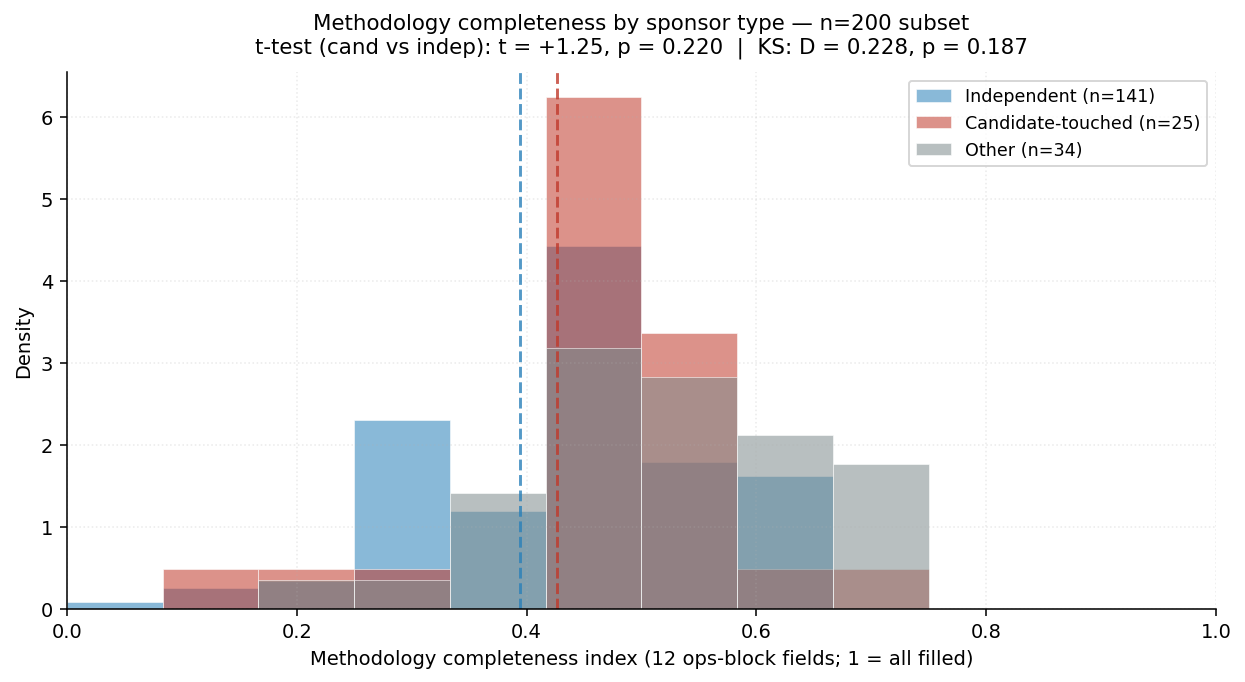
Methodology completeness is HIGHER for candidate-touched polls (mean 0.43) than independent (0.39) — the opposite of Channel A's "candidates hide methodology" prediction. t = +1.25, p = 0.22 (wrong-signed and underpowered). Suggests Channel A on disclosure quantity is not the operative mechanism on this subset.
Question
Even without singling out one methodology lever, the share of the methodology schema actually filled in is itself a Channel-A signal: a pollster who minimizes disclosure has more room to slant without it showing up in any of the four cross-tabs we're running on specific levers. AN-019 showed that candidate-touched polls aren't dramatically more selective in coverage_class; AN-021 showed audit_pct distributions overlap heavily. The completeness index asks the shape-of-disclosure question directly.
Design
Per-poll completeness index = share of K operations-block boolean /
categorical fields that are NOT not_specified / null / False. K is
the count of substantive disclosure fields in the schema (mode,
collection_device, audit_method, interviewer_training_described,
data_consistency_checks, re_contact_verification,
supervisor_role_described, funding_source_mentioned,
question_order_described, geolocated, scenarios_described,
name_rotation). A pollster who says "not_specified" / "False" on
every field gets 0; one who fills every field gets 1.
Histogram of the index by sponsor_type (independent / candidate_touched / other). Two-sample t-test + KS test for the candidate-vs-independent gap.
Results
| bucket | n | mean | median | sd | range |
|---|---|---|---|---|---|
| independent | 141 | 0.394 | 0.417 | 0.126 | [0.00, 0.58] |
| candidate_touched | 25 | 0.427 | 0.417 | 0.119 | [0.08, 0.67] |
| other | 34 | 0.480 | 0.500 | 0.125 | [0.17, 0.67] |
t-test (cand vs indep): t = +1.25, p = 0.220. KS test (cand vs indep): D = 0.228, p = 0.187.
Interpretation
The direction is the opposite of the Channel A prediction. If candidate-touched polls were minimizing disclosure to hide methodology choices, we'd expect lower mean completeness. Instead: candidate-touched mean is higher (0.43 vs 0.39), not lower. Neither test rejects the same-distribution null at this sample size — so this is a directional null, not a refutation.
Two reads:
- Candidate-touched pollsters disclose at least as much as independent ones. If true, Channel A on "disclosure quantity" is not the operative mechanism. Slant would have to come from methodology choices within the disclosed schema (specific neighborhoods, low audit) rather than from non-disclosure. AN-019, AN-020, AN-021 show those specific-choice signals are weak too. Cumulatively, the Channel A signal on this n=200 subset is muted across all four cuts.
- "Other" bucket is the highest-completeness group (0.48), but it's also the residual with the loosest interpretation. Worth re-classifying before drawing conclusions.
If the universe-scale rerun confirms candidate-touched completeness ≥ independent completeness, it would meaningfully change the mechanism story: Channel B (residual / fabrication) would carry the load, and the Spec 3 regression's β shrinkage when methodology features are added should be small.
Follow-ups
- Universe-scale rerun (extension): same script, much bigger n_candidate. If the t-test stays wrong-signed at n_cand ≈ 800, the "candidates minimize disclosure" Channel A subprediction is empirically dead.
- Per-pollster completeness fingerprint (extension): aggregate completeness to pollster level. Is it a firm-fixed style? Then the candidate-touched ≥ independent finding might reflect that candidate-touched polls go to firms with already-completer methodology templates (Quaest, Datafolha), not that any firm becomes more disclosive when paid by a candidate. AN-024 (D5) addresses part of this.
- Split completeness by field type (extension): maybe candidate-touched polls fill more boilerplate fields (supervisor_role_described, interviewer_training_described) but less of the substantive ones (re_contact_verification, funding_source_mentioned). A by-field disclosure-rate table would expose that.