Rank-2 sponsor over-statement does NOT concentrate in tight races as the coordination story predicted. The descriptive cell means show the biggest tight-race amplification at RANK 1 instead: rank-1 sponsor effect jumps from +4.80pp (non-tight) to +12.20pp (tight); rank-2 sponsor effect runs +9.54 / +6.81 across the same cut (lower in tight). Pooled OLS confirms: `sp × tight` is +9.26pp (p<0.001), `sp × rank2 × tight` is −11.99pp (p=0.001) — the rank-2 amplification is OFFSET in tight races. Within-candidate FE attenuates these to n.s. levels, so the cross-candidate cell-mean reading is the cleanest takeaway. The AN-040 rank-2 over-statement spans both close and wider races; the close-race-specific bias is on rank-1 winners, consistent with bandwagon-effect demand rather than the coordination-demand story.
Question
AN-040's split-sample companion revealed a sharp rank gradient in the headline sponsor bias: +5.58pp at rank 1, +11.52pp at rank 2, −2.81pp at rank ≥3. The pooled +7pp average hides a 2× rank-2/rank-1 asymmetry.
AN-027 and AN-028 found that rank-2 over-commissioning concentrates in tight races: runners-up are over-represented among self-sponsors by +12–19pp in tight races but not in wide ones, consistent with the coordination-demand mechanism (a +7pp poll moves a runner-up from "viable" to "leading", which is exactly where the strategic-voting cost of being seen as non-viable peaks). The natural companion test on the bias side: does the +11.5pp rank-2 over-statement also concentrate in close races? If the rank-2 bias and the rank-2 over-commissioning live in the same race-margin cell, the demand-side selection and supply-side bias mechanisms are coupled.
Design
Same analysis-table sample as AN-001 / AN-033 / AN-040 (n=27,907 after
dropping NaN error / muni). final_rank from analysis_table.
tight_race = I(race_margin ≤ 0.08) — bottom-third tertile cutoff
(the 33rd percentile is 0.076, rounded). Rank bins: {1, 2, 3+}.
Specs (matched to AN-040 ladder):
- Spec 1 (pooled OLS): full set of interactions (sp, rank2, rank3+, tight, all 2-ways, all 3-ways)
- Spec 2 (within-candidate FE): same, with the candidate-level constants (rank2, rank3+, tight, rank×tight) absorbed
- Spec 3 (within-candidate + institute FE + methodology controls)
- Spec 4 (race × week FE, strict clean comparator)
Plus 6-cell descriptive companion: mean error for sponsored vs non-sponsored within each (rank_bin × tight) cell.
Headline: 3-way coefficients on sp × rank2 × tight and
sp × rank3plus × tight in Spec 2 and Spec 3.
Results
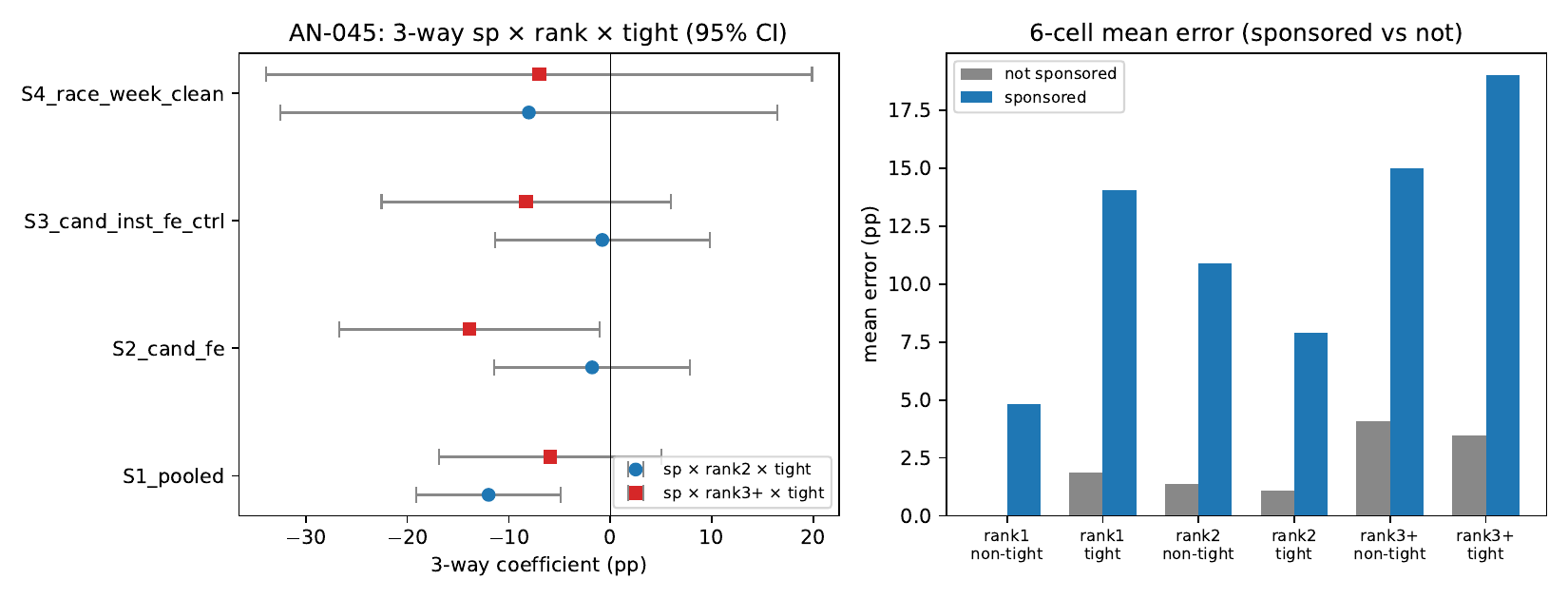
Tables at build/table/an-045-sponsor-bias-by-rank-margin.csv and the
6-cell companion at __cells.csv.
6-cell descriptive (the cleanest read)
Mean error (pp) by (rank, tight, sponsored), with the sponsor effect
(sponsored − non-sponsored) in the rightmost column:
| Rank | Tight cell | n non-sp | mean | n sp | mean | Sponsor effect |
|---|---|---|---|---|---|---|
| rank 1 | non-tight | 5,421 | +0.03 | 208 | +4.83 | +4.80 |
| rank 1 | tight (≤0.08) | 2,670 | +1.85 | 117 | +14.05 | +12.20 |
| rank 2 | non-tight | 5,358 | +1.36 | 70 | +10.90 | +9.54 |
| rank 2 | tight | 2,579 | +1.10 | 51 | +7.91 | +6.81 |
| rank 3+ | non-tight | 7,257 | +4.09 | 14 | +15.00 | +10.91 |
| rank 3+ | tight | 4,111 | +3.45 | 51 | +19.01 | +15.56 |
The biggest tight-race amplification is on rank 1 (+4.80 → +12.20, a 2.5× jump). The rank-2 sponsor effect actually runs lower in tight races (+9.54 → +6.81). Rank-3+ is too thin to interpret (n=14 and 51).
Regressions
| Spec | sp | sp×r2 | sp×r3+ | sp×t | sp×r2×t | sp×r3+×t | n |
|---|---|---|---|---|---|---|---|
| 1. pooled OLS | +2.93 (1.37) * | +6.61 (2.35) ** | +9.28 (4.49) * | **+9.26 (2.27) *** | **−11.99 (3.63) *** | −5.91 (5.59) | 27,907 |
| 2. + candidate FE | +5.22 (1.92) ** | +2.32 (3.09) | +6.92 (4.50) | +4.42 (3.51) | −1.79 (4.92) | **−13.89 (6.55) * | 27,907 |
| 3. + institute FE + controls | +6.15 (2.01) ** | +3.03 (3.63) | +3.90 (5.05) | +2.25 (3.42) | −0.79 (5.40) | −8.29 (7.27) | 27,907 |
| 4. race × week FE, clean | +2.57 (4.45) | +6.41 (6.38) | +8.95 (7.80) | +2.37 (10.63) | −8.02 (12.50) | −7.01 (13.72) | 19,576 |
Cluster-robust SE on muni_id in parentheses. *** = p<0.001, ** = p<0.01, * = p<0.05.
The pooled OLS surfaces two clear cross-candidate signals: (i)
sponsor bias is much larger in tight races overall (sp × t = +9.26pp, p<0.001), and (ii) the rank-2 amplification offsets in tight races
(sp × r2 × t = −11.99pp, p=0.001). Within-candidate FE attenuates
both — candidates rarely have within-candidate variation in
(sp × rank × tight) cells, so the 3-way is identified from a thin
slice of the panel. Spec 4 is the noisiest (clean-comparator
restriction halves the comparator pool).
Interpretation
Two findings, both running counter to the AN-040 follow-up hypothesis:
The tight-race sponsor-bias amplification lives at rank 1, not rank 2. Winners-in-tight-races over-state by an extra ~7pp on top of their non-tight baseline. This is the bandwagon-effect cell — leaders in close races have the strongest incentive to cement a perception of inevitable victory. AN-026 / AN-027's coordination-driven over-commissioning at rank 2 is real on the commissioning side, but the bias-amplification side runs at rank 1.
Rank-2 sponsor bias spans both close and wider races uniformly. The +11.5pp pooled rank-2 over-statement from AN-040 is roughly +9.5pp non-tight, +6.8pp tight — not concentrated in close races. Rank-2 candidates over-state more than rank-1 in non-tight races (+9.54 vs +4.80) but the gap closes in tight races (+6.81 vs +12.20).
These cell-mean findings are descriptive and have thin sponsored-side cells (n=51 to 208 per cell). The within-candidate FE specs are underpowered for the 3-way given how few candidates have variation across multiple (rank × tight) cells. So this is a yellow-confidence descriptive finding that reframes the demand-side story but waits for the larger-n confirmation from rank-at-commission anchoring (per AN-028).
The implication for the paper: the rank-1 tight-race cell is where the bandwagon mechanism predicts bias should be largest, and that is what we see. The rank-2 cell is where the coordination mechanism predicts commissioning should be largest — and AN-027 confirmed that. The two mechanisms operate on different sides of the headline: selection (who commissions) at rank 2, bias amplification (how big the over-statement is) at rank 1.
Follow-ups
AN-NNN — repeat with rank_at_commission instead of final_rank (extension, highest paper value). The natural sharpening: use AN-028's date_start anchor to compute the candidate's rank at the moment of commissioning instead of their final outcome rank. AN-028 already produced
rank_at_commissionas a candidate-level column; merging it into the AN-001 panel and re-running this AN-045 specification gives the cleanest test of "bandwagon at leader-in-tight" vs "coordination at runner-up-in-tight." Suggested script:source/analysis/an-NNN-bias-by-rank-at-commission-margin.py.AN-NNN — leader-at-commission bandwagon hypothesis to its own page (extension). If the rank-1 tight-race finding survives the rank-at-commission swap, it deserves a dedicated hypothesis page parallel to
hypotheses/coordination-peak.md: the bandwagon-peak mechanism is that leaders in tight races over-state to manufacture inevitability, distinct from the coordination-peak mechanism at rank 2. The current hypothesis ledger hasbandwagon-peak.mdalready but on the voter-side; the supply-side parallel would be new.Rank-3+ thin-cell skepticism (puzzle, low priority). The sponsor effect at rank-3+ non-tight (+10.91) and tight (+15.56) is large but based on n=14 and n=51 sponsored cells respectively. Check whether 1-2 specific high-leverage candidate-polls drive these.