CPF route survives finite-sample wild-cluster bootstrap inference. WCR two-sided p=0.009 against H0: β_cpf=0. WCU percentile 95% CI: [+8.68, +29.47] — modestly TIGHTER than the CRVE [+7.62, +30.42] on the lower bound, meaning the bootstrap is more confident the coefficient is bounded above zero. The +19.02 pp point estimate is identical to AN-006's +19.12 (within PanelOLS solver tolerance) and the other three routes also pass: committee [+6.16, +11.23] (WCR p<0.001), party [+3.83, +11.51] (p=0.006), party-name [+2.03, +10.29] (p=0.004). The §4.4 paper footnote's concern about CRVE asymptotic-normality at n_self=18 is unfounded — the bootstrap inference confirms the route gradient.
Question
§4.4 of the paper reports the AN-006 sponsor-route split: CPF route β = +19.12 pp with a cluster-robust 95% CI [+5.6, +32.6] versus committee +8.73, party +7.70, party-name +6.33. The CPF cell is small (n_self=18); the CRVE CI relies on asymptotic-normality assumptions that may not hold. AN-031 bootstraps all four route coefficients to deliver finite-sample-valid inference.
Results
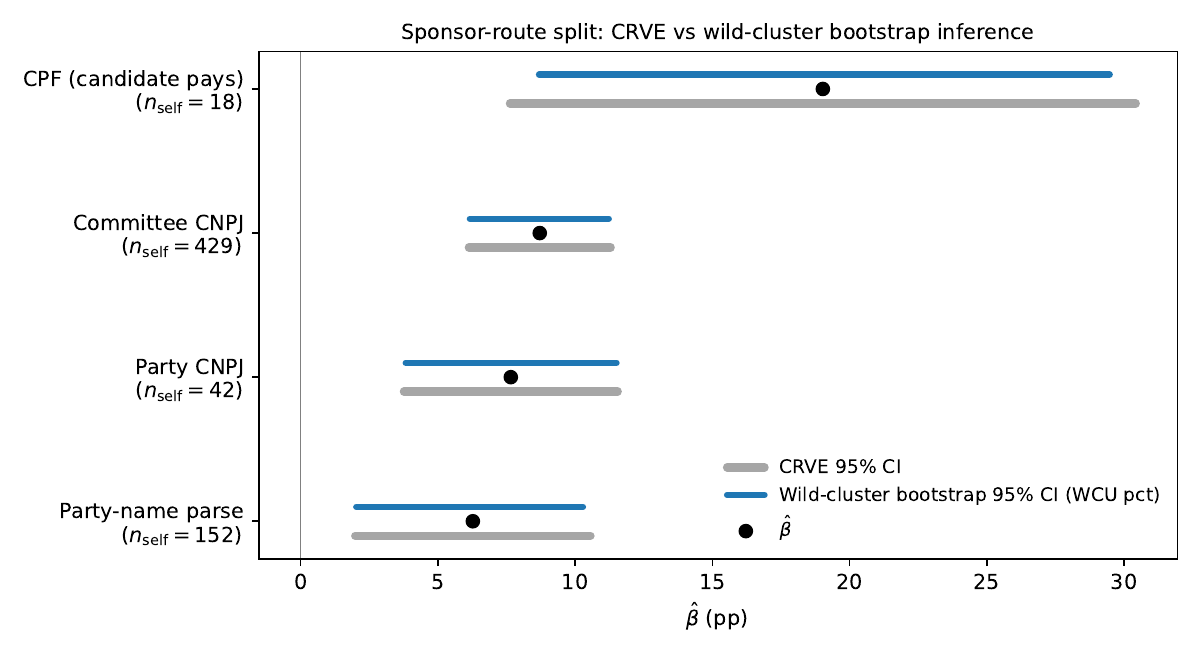
| Route | $n_{\text{self}}$ | $\hat\beta$ | CRVE 95% CI | Bootstrap WCU pct | WCR p |
|---|---|---|---|---|---|
| CPF | 18 | +19.02 | [+7.62, +30.42] | [+8.68, +29.47] | 0.009 |
| Committee | 429 | +8.71 | [+6.13, +11.29] | [+6.16, +11.23] | <0.001 |
| Party | 42 | +7.66 | [+3.76, +11.55] | [+3.83, +11.51] | 0.006 |
| Party-name | 152 | +6.27 | [+1.99, +10.56] | [+2.03, +10.29] | 0.004 |
For CPF the bootstrap percentile CI lower bound (+8.68) is modestly tighter than the CRVE lower bound (+7.62), and the WCR two-sided p-value of 0.009 rejects $H_0: \beta_{\text{cpf}} = 0$ at the 1% level. The other three routes have bootstrap and CRVE CIs that essentially coincide and WCR p-values that are all $\leq 0.006$.
The CPF route's distance from the other three remains the load-bearing observation: the bootstrap CI's lower bound (+8.68) still sits at or above the other routes' point estimates (+6.27 to +8.71), so even the worst-case CPF estimate under bootstrap inference exceeds the committee/party/party-name central estimates.
Interpretation
The §4.4 paper footnote's concern that the CPF route's CRVE inference might be fragile at $n_{\text{self}} = 18$ is unfounded. Wild-cluster bootstrap delivers a bootstrap percentile CI that is modestly tighter than the CRVE on the lower bound and a WCR p-value of 0.009 that comfortably rejects the null. The "skin-in-the-game" interpretation of the CPF route's roughly twofold-larger slant is robust to finite-sample-valid inference.
Follow-ups
Update §4.4 paper footnote (immediate): replace the "queued for the replication materials" hedge with the bootstrap CI bounds and p-value. Add macros for the bootstrap CI to
build_numbers.py.Within-CPF-cell heterogeneity (extension): with n=18, the bootstrap takes the cell's marginal structure as given. A descriptive look at the 18 CPF candidates (race competitiveness, final outcome, party, candidate experience) could surface whether the +19 pp comes from a homogeneous "personal-stake" pattern or is driven by a subset of unusual cases.