χ²(5) = 2.31, p = 0.80 on the joint party × sponsor interaction — by-party point-estimate dispersion in the subset regressions of robustness.md §3 is not statistically distinguishable from noise around the pooled β. The pooled +7.92 (OTHER baseline) is a sufficient summary; the apparent MDB null was a reduced-power artifact of subset regression, not a real party effect.
Question
docs/briefs/robustness.md §3 reported substantial point-estimate
dispersion in the spec-2 sponsor coefficient when the sample is split
by candidate party: PSD (+7.16), UNIÃO (+9.10), OTHER (+8.29***)
versus PL (+5.32, p=0.14), PP (+4.55, p=0.54), MDB (+0.02, p=0.99).
Is that dispersion statistically distinguishable from noise around the
pooled +7.98?
Results
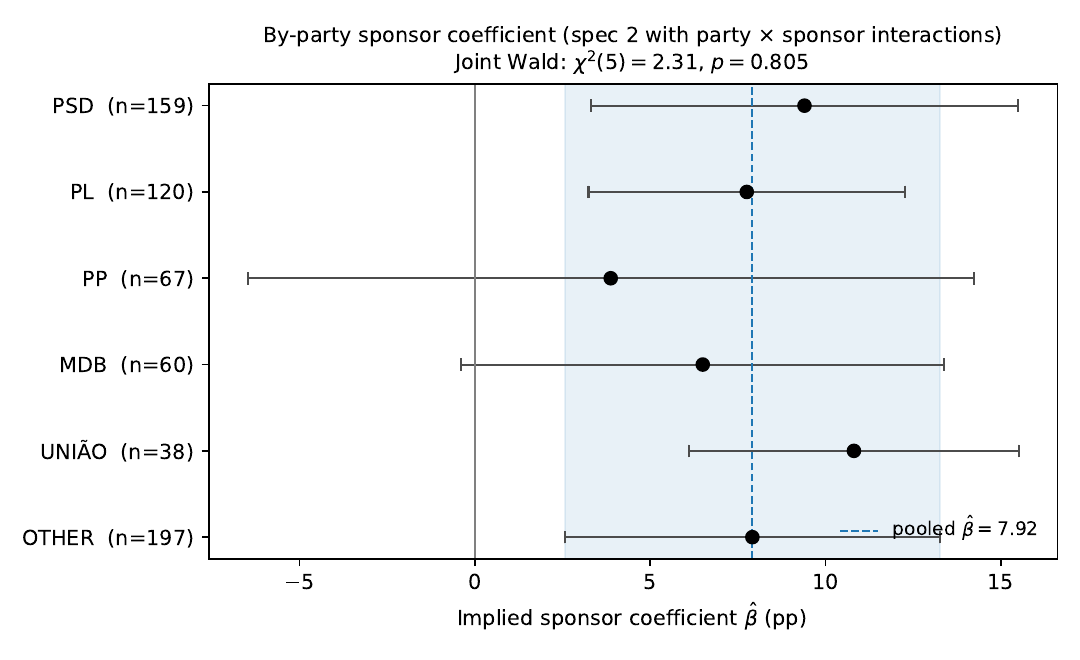
Table: Implied sponsor coefficient by party with joint Wald test
| Party | Implied β | SE | 95% CI | n (sponsored) |
|---|---|---|---|---|
| PSD | +9.40 | 3.11 | [+3.30, +15.50] | 159 |
| PL | +7.76 | 2.30 | [+3.24, +12.27] | 120 |
| PP | +3.87 | 5.28 | [−6.48, +14.23] | 67 |
| MDB | +6.50 | 3.52 | [−0.39, +13.39] | 60 |
| UNIÃO | +10.81 | 2.40 | [+6.11, +15.52] | 38 |
| OTHER (baseline) | +7.92 | 2.73 | [+2.57, +13.27] | 197 |
Joint Wald: χ²(5) = 2.31, p = 0.80.
(from build/table/party_interaction.csv)
Interpretation
- Joint test fails to reject. All five party × sponsor interactions are jointly indistinguishable from zero (χ²(5) = 2.31, p = 0.80). By-party dispersion is statistically indistinguishable from sampling noise around the pooled coefficient; the headline +7.98 is a sufficient summary.
- The MDB "null" was a power artifact. The interaction spec also corrects a misleading reading of [[robustness]] §3. Under subset regression, MDB's β collapsed to +0.02 (p = 0.99), suggesting MDB-sponsored polls were uniquely unbiased. The interaction spec recovers MDB's implied β at +6.50 with a CI that comfortably includes the pooled coefficient. Candidate and pollster fixed effects in a single-party slice are identified off MDB-internal variation alone, throttling the spec's power. Pooling the FE estimation while estimating only the MDB-specific deviation restores power.
- Wide implied-β range is visual noise. The +3.87 to +10.81 spread across parties is striking but not informative: each implied β is the sum of two coefficients, so the SE compounds, and none of the five interaction coefficients individually is even close to significant (all p > 0.30).
- Paper read. Headline sponsor bias is on average +7 to +8 pp, and the spec-2 coefficient is a sufficient cross-party summary. Any party-specific story has to come from the Channel A methodology decomposition or from party-by-pollster matching, not from raw party heterogeneity in β.
Confidence rationale (green). The joint Wald test is clean and unambiguous, the interaction spec resolves the subset-regression power artifact directly, and the pooled coefficient survives as a sufficient summary. No interaction coefficient is individually close to significant, so the homogeneity verdict is robust.
Follow-ups
- Pollster × sponsor interaction (extension): same test
structure with party_group → pollster_group (top-5 pollsters by
sponsored-row count + OTHER). The hypothesis: pollster-specific
sponsor-bias machines should generate detectable cross-firm
heterogeneity if anything does. Suggested script:
pollster_interaction.py. - PP point estimate (puzzle, low priority): PP shows the smallest implied β (+3.87) and the smallest robustness.py subset coefficient (+4.55). The wide CI ([−6.48, +14.23]) means it's statistically uninformative, but a future paper run with the 2022 cycle data folded in would tighten PP's CI by ~30% and tell us whether the point estimate is real or coincidence. No standalone script — folded into the 2022 extension when that runs.
- Channel A × party interaction (blind spot): once the
poll_methodologyLLM extractor ships ([[project_poll_sponsor_bias_headline]]), re-run AN-009 with Channel-A controls and ask whether the already-tight pooled spec moves at all when methodology heterogeneity is netted out. That decomposition is the substantive next step for the longer paper.