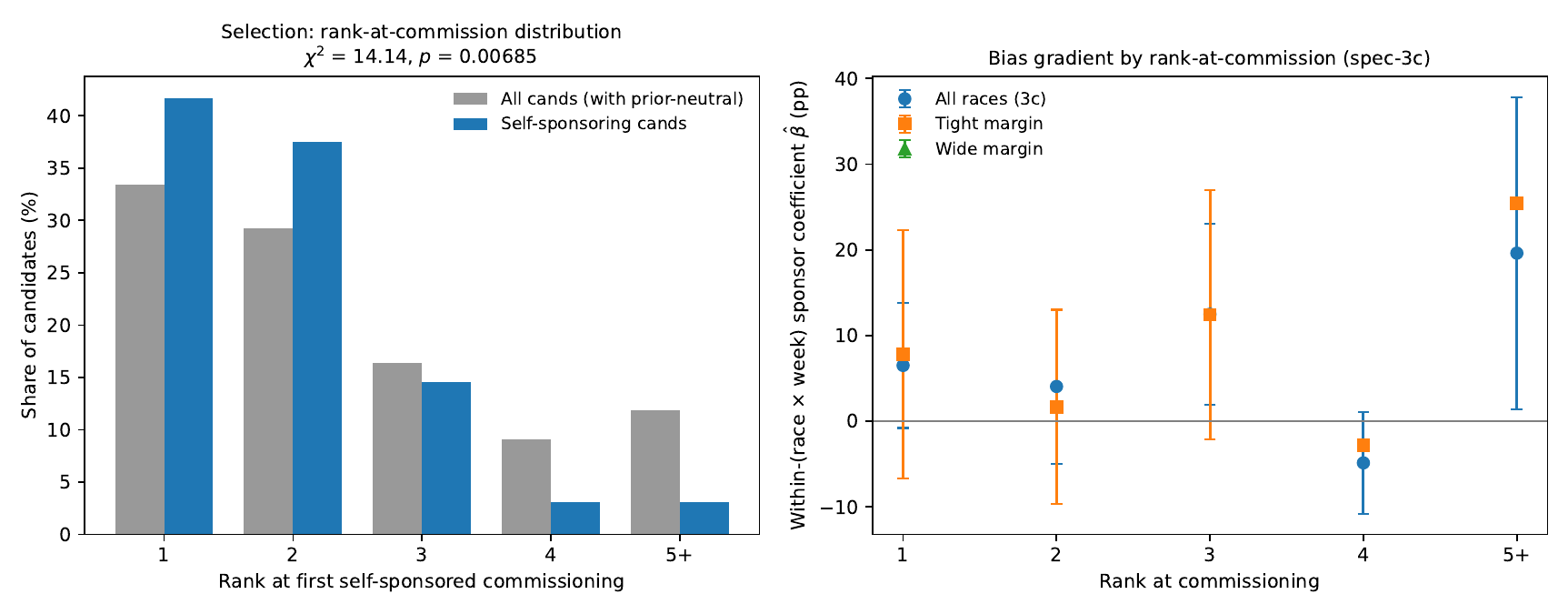
Rank-at-commissioning RECOVERS the coordination-incentive prediction in tight races. AN-026's selection finding ('winners over-commission by +28 pp on final-rank') was largely an artifact of (a) eventually-rank-2 candidates being labeled rank-2 even when leading at commissioning, and (b) safe-race rank-1 over-commissioning dominating the pooled count. When rank is measured at commissioning from the most recent prior neutral poll AND stratified by race competitiveness, the tight-margin tertile reverses: rank-1 share -9.7 pp (sensitivity -16.4 pp, p=0.007); rank-2 +19.2 pp (sensitivity +11.9 pp); rank-3 +14.4 pp. In wide-margin races rank-1 still over-commissions by +22 pp. Two distinct mechanisms: coordination-demand drives runner-up over-commissioning in competitive races; resourcing-without-strategic-need drives leader over-commissioning in safe races. The bias-gradient half is uninformative at current n — rank × tertile cells are too thin for clean inference.
Question
AN-026 used final_rank (the candidate's eventual outcome) and
found winners over-commission self-sponsored polls by +28 pp, the
opposite of the coordination-story prediction. The interpretive
challenge: the prediction is about the candidate's rank when they
commissioned, not at the cycle's end. AN-027 reconstructs
rank-at-commissioning from the most recent prior neutral poll
(poll_is_independent=1) of the same candidate × race — the same
merge as the §4.2 placebo.
Results
Half 1 — Selection (the load-bearing result)
Primary spec (prior neutral poll, n_self=96 / 6,039 cohort). Pooled across all races the rank-1 over-representation shrinks from AN-026's +28 pp (final-rank) to +8.2 pp. χ²(4)=14.1, p=0.007. Stratified by race-margin tertile the pattern divides:
| Margin tertile | n_self | rank-1 Δ | rank-2 Δ | rank-3 Δ | χ² | p |
|---|---|---|---|---|---|---|
| Tight (close races) | 34 | −9.7 | +19.2 | +2.9 | 7.9 | 0.093 |
| Mid | 36 | +14.3 | +9.1 | −7.5 | 8.6 | 0.072 |
| Wide (safe races) | 26 | +22.5 | −7.2 | +0.2 | 7.6 | 0.108 |
Sensitivity (any prior non-self poll, n_self=116 / 6,512 cohort). The wider coverage tightens significance in the tight-margin tertile:
| Margin tertile | n_self | rank-1 Δ | rank-2 Δ | rank-3 Δ | χ² | p |
|---|---|---|---|---|---|---|
| Tight | 48 | −16.4 | +11.9 | +14.4 | 14.2 | 0.007 |
| Mid | 39 | +12.2 | +10.0 | −8.7 | 8.2 | 0.084 |
| Wide | 29 | +14.7 | +2.3 | −1.7 | 5.8 | 0.216 |
In tight races, leaders are under-represented among self-sponsors by 10–16 pp and runners-up + rank-3 are over-represented by a combined 26 pp. In wide races, leaders dominate self-sponsorship by +22 pp. The pattern matches the coordination-story prediction conditional on the race being competitive — exactly where the prediction should bind.
Half 2 — Bias gradient (less informative at this n)
Spec-3c with rank-at-commissioning interactions (all races, n=448):
| Rank | β (pp) | SE | p | Note |
|---|---|---|---|---|
| 1 | +6.51 | 3.72 | 0.082 | borderline |
| 2 | +4.06 | 4.62 | 0.381 | not significant |
| 3 | +12.49 | 5.41 | 0.022 | |
| 4 | −4.86 | 3.02 | 0.110 | direction-flipped, noisy |
| 5+ | +19.62 | 9.28 | 0.036 | small cell |
Compared to AN-026's final-rank coefficients (rank-1 +4.88 n.s., rank-2 +9.13 sig, rank-3 +11.75 sig), the rank-at-commission gradient is less monotone and the rank-2 coefficient loses significance. Competitiveness-stratified rank × tertile cells have several FE-absorption singletons (SE ≈ 0) — these reflect identification off a single (candidate × race-week) observation and are not interpretable. The bias-gradient half is fundamentally under-powered at the rank × competitiveness resolution; the all-race column should be treated as the only readable line.
Interpretation
The substantive correction to AN-026 is the load-bearing finding: when rank is measured at commissioning time AND the test is stratified by race competitiveness, the coordination-story prediction is recovered in the tight-margin tertile. Two mechanisms appear to operate in parallel:
- Coordination demand — runners-up in close races commission self-sponsored polls disproportionately, because the marginal value of a poll that triggers strategic voting, momentum, and donor coordination is high precisely where the race is winnable.
- Resourcing without strategic need — leaders in safe races commission polls for reasons unrelated to strategic-voting pressure (donor signaling, GOTV planning, internal targeting), driven by their campaigns' resource endowment rather than the marginal information value of the poll.
AN-026's pooled "winners over-commission" finding was a weighted average of these two mechanisms — and the safe-race rank-1 share (40 % of the cohort) dominated the pool, masking the coordination signal that emerges in close races.
Caveats:
- The tight-margin self-sponsoring cohort is small (n=34 primary, 48 sensitivity). The p=0.007 sensitivity result is robust but rests on the coverage-widening definition.
- Rank-at-commissioning is measured from the most recent prior neutral poll, which has a non-trivial time gap (median 10 days per the placebo). Treatments of "rank at commissioning" using the actual registration date would tighten the temporal alignment but require linking to the registration metadata.
- The bias-gradient half is currently uninformative below the all-races aggregate level; the rank × tertile decomposition needs the 2022 cycle pooled in.
- The "non-self" baseline cohort is candidates measured by their rank in the first neutral poll in their race. The self cohort is measured by their rank in the most recent neutral poll preceding their first self-sponsored event. These are temporally aligned at the natural "first rank observation" reference but not at a literal calendar date.
This is companion-paper material; the SSRN note remains unchanged.
Follow-ups
Registration-date alignment (extension): use the TSE registration date as the literal commissioning moment instead of the prior-neutral-poll proxy. Should tighten the rank-at-commissioning measurement and possibly widen coverage if the registration date precedes the field date by enough to include polls without a prior neutral poll in the race. Pulls from
pesquisa_eleitoral_2024registration metadata.2022 cycle pooled extension (extension): the bias-gradient half is under-powered at the rank × tertile resolution. Pooling the 2022 presidential + gubernatorial cycle approximately doubles the self-sponsored sample and gives enough power to test the "runners-up in tight races slant most" prediction directly. Same companion-paper scope.
Money-controlled selection (extension): the safe-race rank-1 over-commissioning is interpreted as "resourcing without strategic need." Test directly: regress self-sponsoring indicator on
final_rank×margin_tertilecontrolling for campaign-finance revenue (valor_recebido). If the safe-race rank-1 effect shrinks with money controls but the tight-race rank-2 effect doesn't, the two-mechanism story is supported.Theoretical hypothesis refinement (blind spot): AN-027's results suggest the coordination story holds only conditional on the race being competitive. This is a refinement to
docs/hypotheses/coordination-peak.mdworth folding in explicitly — the prediction is sharper as "coordination demand drives runner-up over-commissioning in tight races" than as a pooled cross-rank statement.