The direct name-order priming test refutes the sponsor-exploitation reading. On 196 of 244 pairs (after fuzzy name-matching), the sponsor's own candidate appears LATER on the sponsored side than on the matched independent side — sp first-position rate 20.4 % vs ind 30.1 % (McNemar p = 0.001 in the WRONG direction). Sponsored polls do not strategically order their candidate to exploit first-position priming. The within-pair bias-carrier test IS significant (MW p = 0.019) but on the small 17-pair subset where sp lists the candidate earlier — when priming is used, bias is higher; sponsors generally do not use it.
Question
AN-051 established that sponsored polls under-document rotation by 4-5× compared to matched independents. The natural follow-up: in the modal case where the questionnaire uses a fixed printed order (no rotation), does the sponsor's own candidate appear earlier in that order than they appear on the matched independent side? If yes, sponsored polls strategically exploit first-position priming. If no, the rotation gap may be a documentation artifact (or a firm-tier composition effect — see AN-052) that doesn't translate into actual order manipulation.
Design
For each of the 244 curated pairs, the script loads the per-protocol
JSON output from the questionnaire extractor, identifies the
headline estimulada scenario, and fuzzy-matches
sponsor_cand_name (from curated_pairs/pairs_with_extractions.parquet)
against the candidates_listed roster. Non-candidate options
(Branco/Nulo/Indeciso/NS/NR/Outro) are filtered out before
computing positions. After upgrading the matcher to handle Brazilian
nickname variants ("JOAO JORGE FADEL FILHO" ↔ "João Fadel"), 196 of
244 pairs pass the filter on both sides.
Tests on the 196-pair sample:
- Paired Wilcoxon on
sp_position - ind_position(raw and normalized by roster length). - Sign test on the direction of the position difference.
- McNemar on the binary indicator
P(candidate listed first)comparing sponsored vs independent. - Mann-Whitney bias-carrier test: among pairs where the candidate's position differs, does the within-pair bias contrast track which side has the candidate earlier?
Results
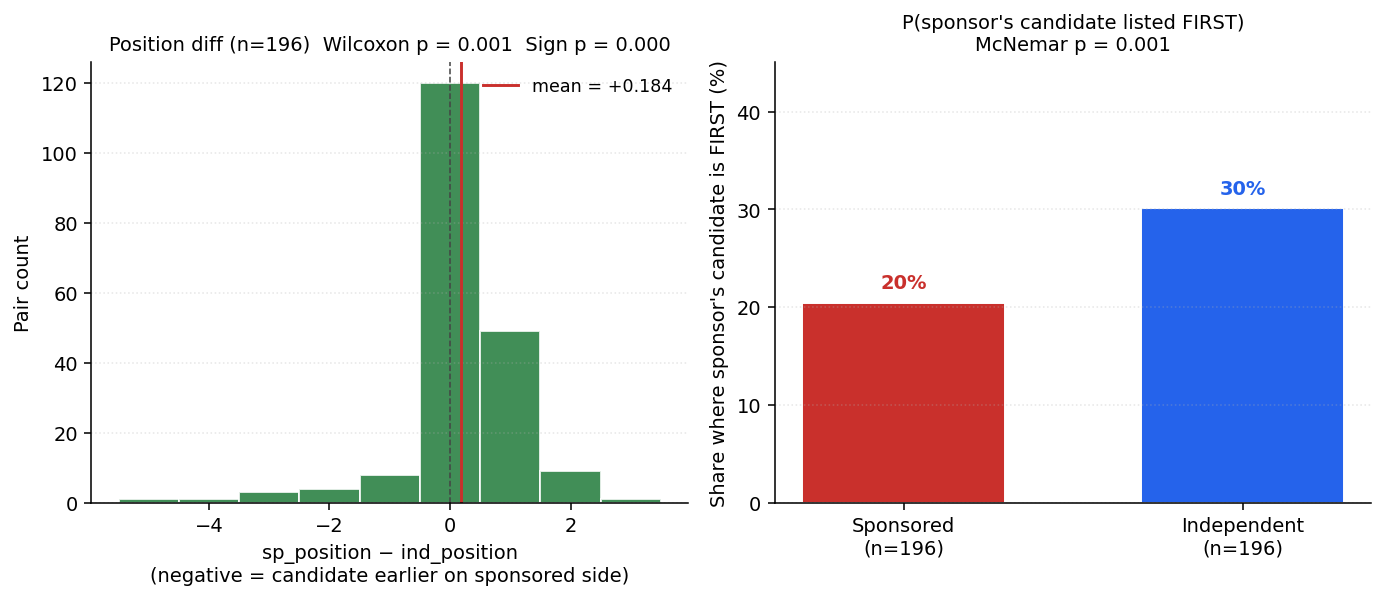
Headline contrasts (n = 196):
| Metric | Sponsored | Independent | Δ |
|---|---|---|---|
| Mean raw position | 2.93 | 2.74 | +0.19 |
| Mean normalized position [0, 1] | 0.488 | 0.401 | +0.087 |
| P(candidate listed FIRST) | 20.4 % | 30.1 % | −9.7 pp |
| Mean real-candidate roster length | 5.09 | 5.17 | −0.08 |
Within-pair direction (n = 196):
| Direction | n | % |
|---|---|---|
| Sponsor's candidate EARLIER on sponsored side | 17 | 8.7 % |
| Sponsor's candidate LATER on sponsored side | 59 | 30.1 % |
| Same position | 120 | 61.2 % |
- Wilcoxon raw position diff: p = 0.0009 (sign: sp later)
- Wilcoxon normalized: p = 0.00002 (sign: sp later)
- Sign test on the 76 differing pairs: p < 10⁻⁵ (sign: sp later)
- McNemar on
first_positionindicator: b = 6 (sp_first only), c = 25 (ind_first only), p = 0.001 (sign: sponsored polls are less likely to list the sponsor's candidate first)
Bias-carrier:
| Subset | n | Mean contrast (sp_error − ind_error) |
|---|---|---|
| Candidate EARLIER on sp side | 17 | +9.69 pp |
| Candidate LATER on sp side | 59 | +3.44 pp |
| Mann-Whitney p | — | 0.019 |
When sponsored polls do list the candidate earlier (rare, 8.7 %), the bias contrast is roughly 2-3× larger than when they list the candidate later. The 17-pair "earlier-on-sp" subset has mean contrast nearly double the overall +5.46 pp.
Interpretation
The direct test of name-order priming as a sponsor-exploitation lever is refuted on this sample. Sponsored polls systematically list the sponsor's own candidate later in the headline roster than matched independents do, not earlier. The first-position rate is also lower (20.4 % vs 30.1 %, McNemar p = 0.001). Whatever drives the printed candidate order on sponsored questionnaires — alphabetical, by número de urna, by party — it is not "put the sponsor's candidate first to exploit priming".
The 30 % of pairs where the candidate's position differs run the opposite way to priming: 59 pairs sp-later vs 17 sp-earlier. If sponsors were systematically manipulating candidate order, the ratio should run the other way.
The bias-carrier result is the interesting wrinkle. Conditional on a position difference, sponsored polls that do list the candidate earlier have a +9.69 pp contrast — almost double the +3.44 pp for the more common "sponsored later" cases. So when priming is used, it appears to operate (or at least co-vary with the slant). But sponsors do not systematically use it. The 17 "early-on-sp" pairs are not the modal sponsor strategy.
Two readings:
Sponsors don't exploit position priming because the firms they hire don't. Combined with AN-052's firm-FE attenuation, the rotation-and-position findings cluster into a firm-tier story: the smaller / lower-discipline firms sponsors choose use whatever order convention is built into their questionnaire template (often by-número-de-urna, which orders by party number and doesn't favor sponsors), and don't apply a priming-aware design.
Sponsors exploit priming when they can, but most of the time the questionnaire is template-driven. The 17 "early-on-sp" pairs are the strategic-priming cases (highest bias contrast); the rest are firm-template noise.
Either way, this AN refutes the simple "sponsors put their candidate first to slant the poll" reading. The +5-7 pp headline sponsor bias cannot be quantitatively attributed to candidate- position priming in this sample.
Combined with AN-052, the AN-051 rotation finding is now a firm-tier composition signal, not a direct sponsor-side Channel-A lever:
- AN-051: sponsored polls under-document rotation 4-5× (marginal, between-firm).
- AN-052: the contrast vanishes within firm — firms are internally consistent.
- AN-053: sponsored polls do not order the sponsor's candidate earlier; if anything, they list the candidate later (Wilcoxon p < 10⁻⁴).
Net: rotation and candidate ordering are firm-template features that sponsors get by selecting which firm to hire, not by instructing the chosen firm to design slant-favorable questionnaires. The lever lives one level upstream — at firm choice, not questionnaire design.
Follow-ups
Demote rotation from source-of-bias.md's "Concrete design- choice differences" table (writeup, immediate). AN-052 and AN-053 jointly show the rotation gap is firm-tier composition, not a within-firm sponsor lever. Move it to a new section on firm-tier consequences, or fold it into the existing AN-018 firm-size discipline narrative.
Combined-evidence brief on the questionnaire layer (writeup). AN-051 / AN-052 / AN-053 together tell a coherent story that should live in one place. Either a new brief under
docs/briefs/questionnaire-layer.mdor an addition to the existingfindings/poll-methodology-paired.md. Surface the firm-tier interpretation to coauthors.What DOES order the candidates on the sponsored side? (puzzle, follow-up). The roster sometimes uses by-número (10/12/13/15/22/33), sometimes alphabetical, sometimes "by_listed" with no obvious rule. A descriptive cut on the sponsored-side rosters identifying which convention each firm uses would clarify: are sponsors' firms systematically using by-número (which is institute-neutral) vs alphabetical (which advantages first-letter candidates)? Suggested script:
source/analysis/an-NNN-roster-order-conventions.py.17-pair "sponsor-earlier" puzzle (puzzle, low priority). The 17 pairs where sp lists the candidate earlier have +9.69 pp mean bias contrast. Are they concentrated on specific firms, specific candidates, or specific muni-types? Spot-read for any pattern. Bias-carrier test is significant (MW p = 0.019) but on a small subset.