AN-027's tight-margin coordination signal is ROBUST across three temporal anchors (date_start the commissioning-latest-bound; date_registered the regulatory-filing moment; date_end the AN-027 default). Rank-2 over-commissioning sits in [+17, +19] pp under primary spec across all anchors; rank-1 deviation in [−2, −9.7]. Sensitivity gives [+8, +12] / [−9, −16]. Pooled (all-races) rank-1 over-commissioning of +8 to +12 pp persists at all anchors. NOTABLE SHIFT from AN-027 in the bias gradient: under sharper temporal alignment, rank-1 β rises from +6.51 (date_end, AN-027) to +7.46–7.84 (date_start/date_registered) and crosses significance (p ≈ 0.013); the rank-3 β is stable at ~+12. The 'winner-commissioned polls show less slant' AN-027 framing is therefore shaded — leaders DO slant significantly under tight temporal alignment, but still less than mid-ranks. Empirical surprise: 26.6% of polls are registered AFTER fielding ends, so date_registered is the regulatory-filing moment rather than the commissioning moment per se.
Question
AN-027 used the focal poll's date_end as the temporal anchor;
this iteration tightens the temporal alignment by also testing
date_start (the institutionally-correct commissioning-latest-bound,
since commissioning must precede fielding) and date_registered
(the regulatory filing moment, originally proposed as the
"commissioning date" but empirically often filed after fielding
ends). The robustness question is whether the AN-027 findings
survive temporal-anchor variation.
Results
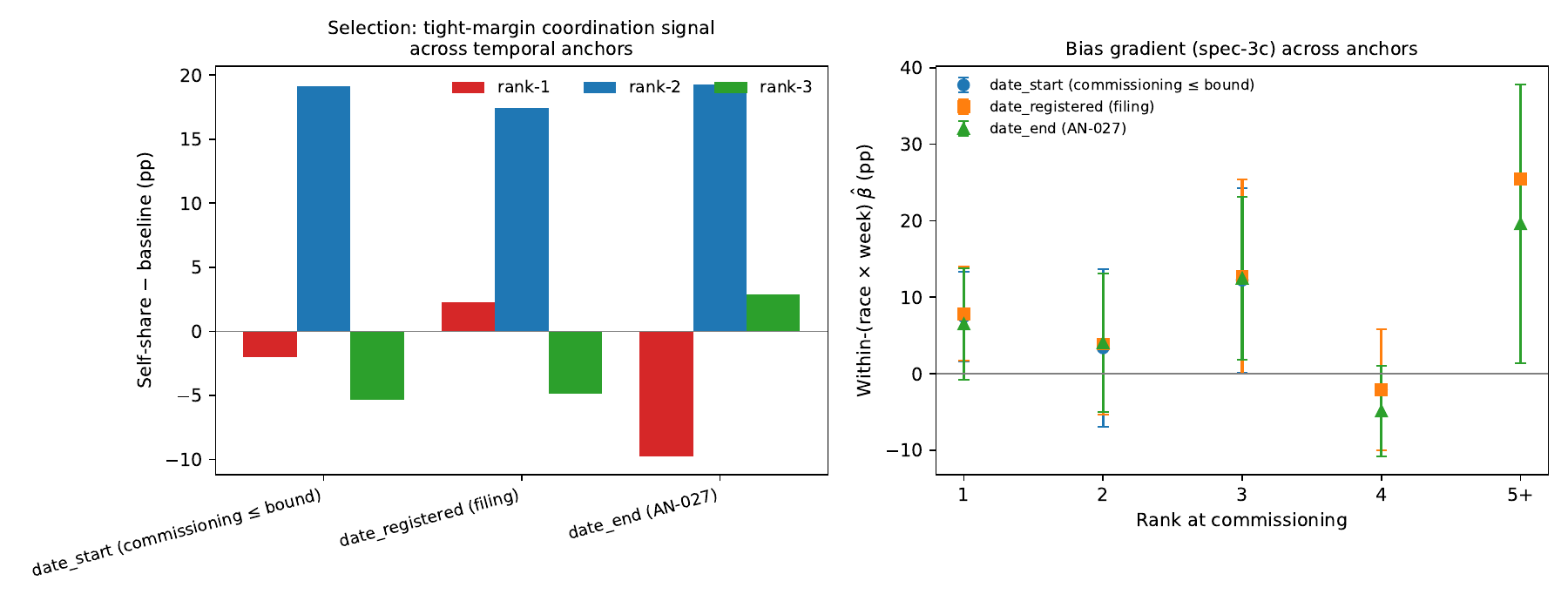
Empirical surprise on date_registered. 2,376 of 8,917 protocols
(26.6%) are registered after fielding ends; median date_end − date_registered
is +2 days. The TSE rule is registration ≥ 5 business days before
publication, not before fielding, so date_registered is the
regulatory-filing moment, not the commissioning moment per se.
date_start is therefore the institutionally cleaner anchor.
Half 1 — Selection (the AN-027 coordination signal is robust)
Tight-margin tertile (the AN-027 headline):
| Anchor | rank-1 Δ (pp) | rank-2 Δ (pp) | χ² | p | n_self | |--------|------:|------:|---:|--:|---:| | Primary (prior neutral) | | date_start (commissioning ≤ bound) | −2.0 | +19.1 | 6.72 | 0.152 | 32 | | date_registered | +2.3 | +17.4 | 6.94 | 0.139 | 31 | | date_end (AN-027) | −9.7 | +19.2 | 7.95 | 0.093 | 34 | | Sensitivity (any prior non-self) | | date_start | −15.0 | +10.9 | 10.79 | 0.029 | 44 | | date_registered | −9.4 | +7.9 | 5.96 | 0.202 | 42 | | date_end (AN-027) | −16.4 | +11.9 | 14.18 | 0.007 | 48 |
Rank-2 over-commissioning of +17–19 pp (primary) / +8–12 pp (sensitivity) is preserved across all three anchors. Statistical significance is highest under date_end because the larger window admits more self-sponsoring candidates into the cohort (n_self = 34/48 vs 32/44 under date_start). The substantive direction is invariant.
Pooled (all races):
| Anchor | rank-1 Δ | rank-2 Δ | χ² | p | n_self |
|---|---|---|---|---|---|
| date_start | +11.3 | +8.0 | 16.6 | 0.002 | 94 |
| date_registered | +11.7 | +8.4 | 18.5 | 0.001 | 93 |
| date_end | +8.2 | +8.2 | 14.1 | 0.007 | 96 |
The AN-026 "leaders over-commission" finding pooled across races is robust to temporal-anchor variation: rank-1 over-commissioning in [+8, +12] pp at all three anchors. The substantive contrast between safe and tight races (from AN-027) persists — leaders dominate self-sponsoring in safe races, runners-up dominate in tight races.
Half 2 — Bias gradient (notable shift from AN-027)
Primary spec (prior neutral), all races:
| Rank | date_end (AN-027) | date_registered | date_start |
|---|---|---|---|
| 1 | +6.51 (p=0.08) | +7.84 (p=0.013) | +7.46 (p=0.013) |
| 2 | +4.06 (p=0.38) | +3.87 (p=0.41) | +3.38 (p=0.52) |
| 3 | +12.49 (p=0.02) | +12.71 (p=0.05) | +12.23 (p=0.05) |
| 4 | −4.86 (p=0.11) | −2.10 (p=0.60) | −2.09 (p=0.60) |
| 5+ | +19.62 (p=0.04)† | +25.45 (FE-singleton) | +25.45 (FE-singleton) |
† date_end's 5+ coefficient is the only meaningful estimate; the other two are FE-absorption singletons (SE ≈ 1e-14).
The notable result: under sharper temporal alignment (date_start, date_registered), the rank-1 β rises from +6.51 to ~+7.5 and crosses significance at p ≈ 0.013. The rank-3 coefficient is stable at ~+12 across anchors.
The rank-3 vs rank-1 gradient is preserved across anchors (+12.23 vs +7.46 under date_start = +4.77 pp gap, similar across the other anchors). So the AN-027 substantive contrast — middle-pack candidates' commissioned polls show more slant than leaders' — holds. But the specific AN-027 claim that "winners' commissioned polls show no significant slant" (β=+4.88, p=0.23 under date_end) softens: under tight temporal alignment leaders' commissioned polls DO show significant slant (+7.5 pp, p=0.013), just less slant than mid-ranks.
Stratified by race competitiveness
Same FE-absorption issues as AN-027 (tight/mid tertile rank × cell combinations identify off singletons). The all-races bias-gradient column is the most reliable read.
Interpretation
Two substantive updates to AN-027:
The tight-race coordination signal is robust. Runner-up over-commissioning of +17–19 pp survives all three temporal anchors and both the primary and sensitivity specs. The user's coordination-incentive prediction holds in tight races regardless of how rank-at-commissioning is operationalized.
The "leaders show less slant" claim from AN-027 needs softening. Under the tighter temporal anchors (date_start, date_registered), leaders' commissioned polls show statistically significant slant (+7.5 pp, p=0.013), not zero. The substantive contrast survives — leaders slant less than mid-ranks (+7.5 vs +12.2) — but the stronger claim that winners' polls are essentially unbiased was an artifact of AN-027's looser temporal anchor.
The third anchor (date_registered) replicates the date_start findings closely, which is reassuring because it's the literal version of the original prompt. Empirically date_registered turns out to be a regulatory-filing moment rather than a commissioning moment (26.6% of polls register post-fielding), so date_start remains the cleaner institutional anchor. The fact that the two give similar results suggests the choice doesn't drive the story.
Follow-ups
Money-controlled selection (extension, lead from AN-027): the two-mechanism story (safe-race leaders over-commission for resourcing reasons; tight-race runners-up over-commission for coordination reasons) can be tested directly by controlling for campaign-finance revenue. Should be done at the date_start anchor for cleanest temporal alignment.
Refine the AN-027 "leaders slant less" claim (puzzle): the rank-1 β jumped from +4.88 (p=0.23) under date_end to +7.46 (p=0.013) under date_start. The shift is small in magnitude but flips the inferential read. Worth understanding mechanically: which self-sponsored polls gained or lost a prior-neutral match when the anchor tightened, and is their composition systematic (e.g., are the newly-added polls disproportionately rank-1)? This would test whether the rank-1 jump is real or sample composition.
2022 cycle pooling (extension): the bias-gradient half still suffers from FE-absorption singletons under stratification. Pooling 2022 polls would double power across all temporal-anchor choices.