The 200-poll subset has 0 CPF polls. Committees (n=6) are 83% deferred-to-complement — hide scope via the complement channel, never selective. Party-route polls (n=4 total) are 50% specific_neighborhoods — small-n hint that party sponsors pick the selective channel.
Question
AN-019 found a small slant-permissive coverage gap (12% vs 10%) between candidate-touched and independent polls on the n=200 methodology subset. This finer split asks: among the candidate-touched routes (CPF / committee / party / party_name), does one route concentrate the worst coverage classes? The own-CPF route showed β = +19 in AN-006 — if Channel A drives that, we'd expect CPF-sponsored polls to also have the most-selective coverage classes.
Design
Same sample (n=200) as AN-019. Per-protocol classification:
- If any sponsor has
sponsor_routein {cpf, committee, party, party_name}, the protocol takes that route as its label (with a precedence order in case multiple routes appear: cpf > committeeparty > party_name — same as the heterogeneity script).
- Else if the protocol has only media / pollster_self sponsors:
independent. - Else:
other.
Cross-tab + row shares + column shares.
Results
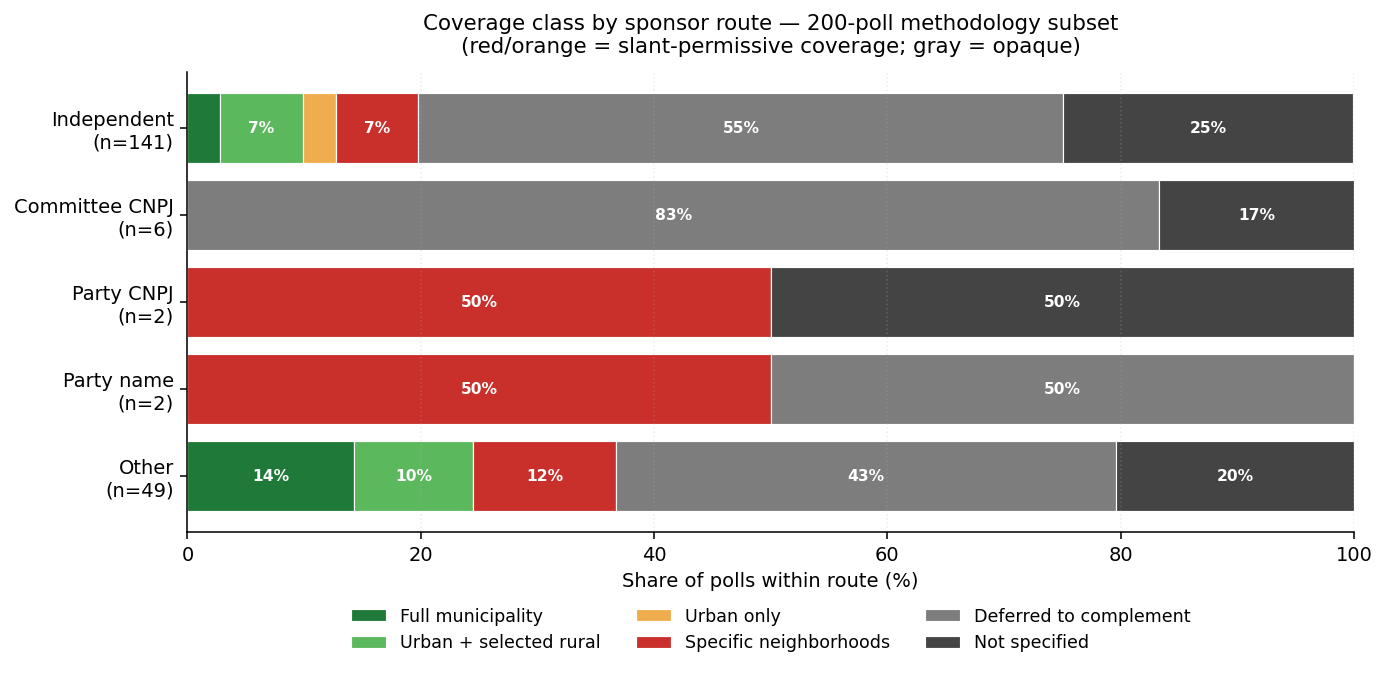
Per-route distribution on the n=200 methodology subset:
| route | n | full_muni | urban+rural | urban_only | spec_nbhd | deferred | not_spec |
|---|---|---|---|---|---|---|---|
| independent | 141 | 2.8% | 7.1% | 2.8% | 7.1% | 55.3% | 24.8% |
| committee | 6 | 0% | 0% | 0% | 0% | 83.3% | 16.7% |
| party | 2 | 0% | 0% | 0% | 50% | 0% | 50% |
| party_name | 2 | 0% | 0% | 0% | 50% | 50% | 0% |
| other | 49 | 14.3% | 10.2% | 0% | 12.2% | 42.9% | 20.4% |
| cpf | 0 | — | — | — | — | — | — |
Interpretation
The 200-poll stratified subset (78 substantive + 85 deferred + 37 very-short) contains no CPF-sponsored polls — all 18 CPF sponsorships across the universe fell outside the sample. AN-006's β = +19 finding for CPF can't be probed for Channel A signal on this subset; have to wait for the universe extraction.
For the routes that ARE present, two distinct patterns emerge:
- Committee-route polls (n=6) hide via deferral. All 6 committees choose either deferred (83%) or not-specified (17%). None pick a selective coverage class. Committees may treat coverage as boilerplate-deferred-to-complement, like the independent baseline (55% deferred). The committee mechanism, if there is one, is in the complement document — outside our LLM extraction.
- Party-route polls (n=4 total) pick selective classes. 2 of 4 are specific_neighborhoods (50%) — much higher than independent's 7%. Tiny n, but the qualitative pattern matches the Channel A prediction more cleanly than committees do. Party-level coordination may use the active coverage-restriction lever in a way committees don't.
The "other" residual (49) again shows the highest full_municipality share (14%) — these are pollsters that don't follow the deferral convention. Re-classifying them via the LLM sponsor-classifier refinement would shift some toward candidate-touched.
Confidence: red. With committee n=6 and party n=2+2, no inference is robust. The qualitative differences (committees use deferral, party uses selective classes) are suggestive enough to flag but need confirmation at universe scale.
Follow-ups
- Refit on the universe extraction with CPF cell populated (extension): re-run when the methodology LLM pass covers all 14,876 protocols. Two key magnitudes to watch: (a) Does the committee/party split survive? — committees-defer, party-select would be a clean two-channel finding. (b) Where do the 18 CPF polls land — selective like party, opaque like committee, or neither?
- Pull complement documents for the 6 committee-deferred protocols (blind spot): if committees route their selective coverage choices into the complement document rather than the initial filing, those complements are extracted separately (TSE distributes them alongside the relatorios). The LLM methodology pass currently covers only the main DS_DADO_MUNICIPIO field. Extending to the complement document would close this blind spot.
- Check whether sample stratification dropped CPF polls (puzzle): the n=200 subset was stratified by cov_bucket. Are CPF polls disproportionately in a bucket not sampled (probably "very_short" if they're informal), or evenly distributed? A stratification audit would say whether the universe extraction will recover them.