Coordination-incentive prediction fails on selection (rank-1 winners *over*-commission by +28 pp; runners-up *under*-commission by −8 pp; χ²(4) = 169, p < 10⁻³⁵) but partially holds on the bias gradient (spec-3c: rank-1 β = +4.88 pp, p = 0.23, NOT significant; rank-2 β = +9.13 pp, p = 0.01; rank-3 β = +11.75 pp, p = 0.02; rank-4 β = +13.80, p = 0.02; rank-5+ β = +5.24, p = 0.26). The two halves point to a refined mechanism: winners commission polls in greater numbers (resourced campaigns can afford polling) but the slant on winner-sponsored polls is smaller and insignificant — the marginal value of a *slanted* poll, not the marginal value of *a* poll, varies by rank.
Question
The coordination/bandwagon literature predicts that the marginal value of commissioning a biased poll depends on the candidate's eventual position in the race. A leading candidate's information is "we are winning"; the additional value of a biased poll is small. A runner-up's biased poll has high marginal value — it can shift voters toward strategic coordination, trigger fundraising momentum, and generate media coverage that the underlying position would not. The prediction has two distinct halves:
- Selection. Are self-sponsors disproportionately runners-up?
- Bias gradient. Conditional on commissioning, does slant β vary by rank?
Design
Two coordinated cuts on build/analysis_table.parquet. Selection
uses one row per candidate (conditional on running in a race with at
least one poll), comparing the rank distribution of self-sponsors to
the all-candidate baseline via multinomial χ². Bias gradient uses
spec-3c (clean comparator + race × week FE) with
sponsored_by × C(final_rank) interactions. Both stratified by
race_margin tertile.
Results
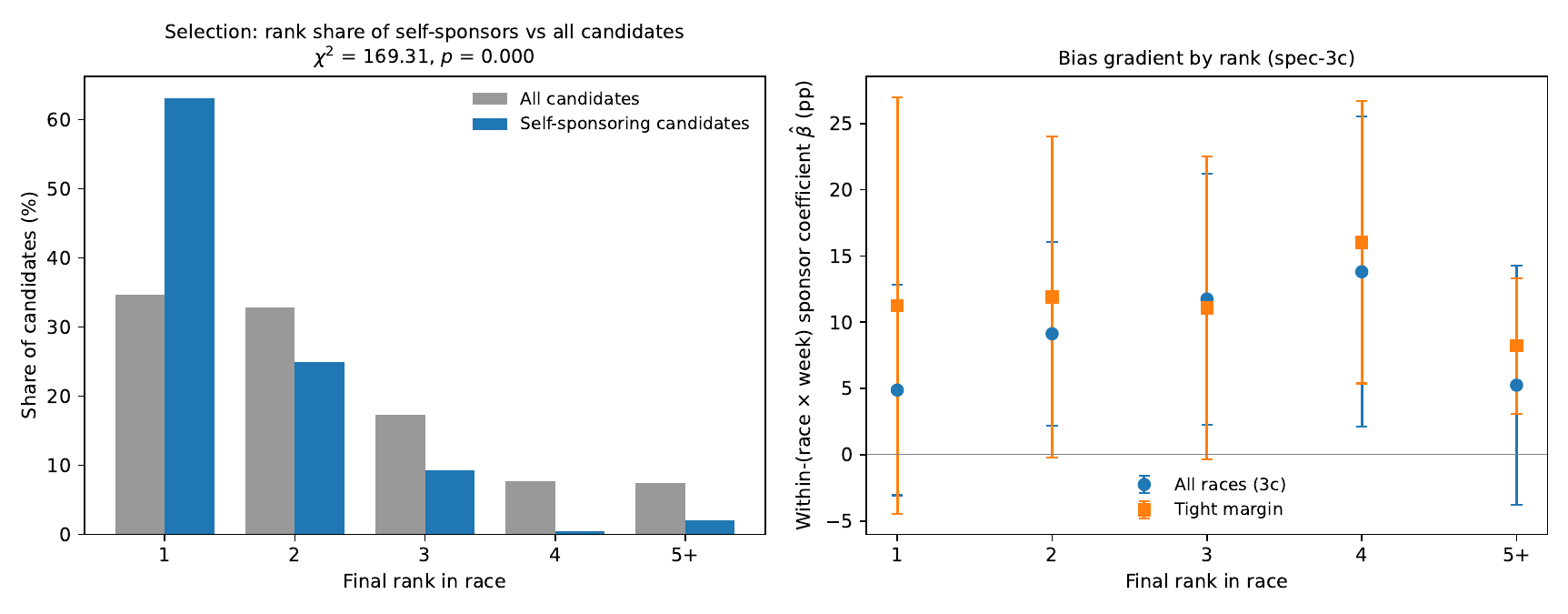
Half 1 — Selection (statistically very clean)
| Rank | All-candidate baseline | Self-sponsor share | Δ (pp) |
|---|---|---|---|
| 1 | 34.7 % | 63.1 % | +28.4 |
| 2 | 32.8 % | 25.0 % | −7.8 |
| 3 | 17.4 % | 9.3 % | −8.0 |
| 4 | 7.7 % | 0.5 % | −7.3 |
| 5+ | 7.5 % | 2.1 % | −5.4 |
χ²(4) = 169, p < 10⁻³⁵, n_candidates = 8,225, n_self = 428. Direction is opposite the coordination-story prediction. Rank-1 winners over-commission massively; runners-up and lower ranks all under-commission relative to baseline. The result is robust across race-competitiveness tertiles:
| Margin tertile | rank-1 Δ | rank-2 Δ | χ² | p |
|---|---|---|---|---|
| Tight (close races) | +21.2 | −6.2 | 44.6 | 4.9 × 10⁻⁹ |
| Mid | +24.8 | +1.3 | 46.4 | 2.0 × 10⁻⁹ |
| Wide (safe races) | +41.0 | −15.8 | 106.3 | 4.4 × 10⁻²² |
Winners dominate self-sponsorship even more in safe races (+41 pp) than in close ones (+21 pp). One natural reading: winners commission because they have the resources, and uncontested winners commission more because the campaign apparatus is at its peak rather than because the strategic stakes are.
Half 2 — Bias gradient (smaller n, suggestive)
Spec-3c with rank interactions:
| Rank | β (pp) | SE | p | Note |
|---|---|---|---|---|
| 1 | +4.88 | 4.05 | 0.23 | not significant |
| 2 | +9.13 | 3.55 | 0.01 | |
| 3 | +11.75 | 4.83 | 0.02 | |
| 4 | +13.80 | 5.97 | 0.02 | |
| 5+ | +5.24 | 4.61 | 0.26 | not significant |
n = 448, 60 race-weeks. Compared to AN-004's spec-2 numbers (rank-1 +7.55, rank-2 +9.30, rank-3 +7.76, rank-4 +8.87, rank-5+ +3.36), tightening to spec-3c moves the winner coefficient down (+7.55 → +4.88, lose significance) and the rank-3/4 coefficients up (~+7.8 → +11.8 / +13.8, gain significance).
Competitiveness stratification suffers from thin cells (190 rows in tight tertile, 209 in mid) and a few FE-absorption singletons (margin_mid rank-4 SE = 0.23; rank-5+ SE ≈ 0). The tight-margin slice shows higher β across all ranks (rank-1 +11.3 — but insignificant, p=0.16) which would favor the user's sharper prediction if the n supported inference; with current power the interaction is uninformative.
Interpretation
The two halves point to a refined mechanism rather than confirming the original coordination-incentive prediction:
- Winners over-commission polls (resourced campaigns can afford polling; the apparatus is at its peak when the candidate is winning).
- But winner-sponsored polls show smaller slant under strict identification — the rank-1 spec-3c coefficient is +4.88 (n.s.) versus +9-14 for ranks 2–4. The slant gradient is consistent with the coordination story's marginal-value-of-biased-information logic, but the selection gradient is inconsistent with the marginal-value-of-any-poll logic.
A unified reading: leaders want polls for fundraising, donor signaling, and GOTV planning — uses for which their honest measured position already serves. Runners-up and middle-pack candidates need slant specifically to trigger strategic-voting coordination, fundraising urgency, and media coverage their underlying position cannot generate alone. The marginal value of a slanted poll, not the marginal value of a poll, varies by rank.
Important caveats:
- The
final_rankcoding uses the eventual outcome, not rank at commissioning time. A candidate leading early who finishes second appears as "rank-2"; the prediction is naturally about rank at commissioning. This bias works against the selection finding (eventually-rank-1 candidates were not necessarily rank-1 when they commissioned, so the +28 pp over-representation is an underestimate of the leader-vs-non-leader gap at commissioning). - Spec-3c rank stratification rests on 50-100 rows per rank in a 60-cell sample; the rank-3/4 high coefficients should be treated as suggestive rather than load-bearing.
- The competitiveness interaction is too thin to support the sharper prediction directly — needs the 2022 cycle pooled in.
This result fits the companion paper, not the SSRN note (which defers mechanism work). The note's §5 Channel A vs B paragraph should not be modified on the basis of AN-026; the finding informs the longer paper's discussion of who demands biased polls and why.
Follow-ups
Rank-at-commissioning-time, not final rank (puzzle / extension): reconstruct each self-sponsor's contemporaneous rank from the most-recent prior independent poll (the same pre-poll comparator used in the placebo). Re-estimate both halves with that variable. This sharpens the selection test directly. Suggested script:
source/analysis/an-NNN-rank-at-commission.py. Highest paper value.Strategic-voting outcome (blind spot): AN-026 documents that runner-ups slant more than leaders, consistent with a strategic-voting demand story. The natural complement is a measurement of whether those slanted polls actually shifted strategic voting (rank-2's eventual vote-share gain relative to the pre-poll equilibrium). Needs the lawsuit cross-check or a late-poll-vs-result panel with more cycles.
Resourcing as the selection driver (extension): the "winners are well-resourced" interpretation can be tested directly — control for
valor_recebido(campaign-finance reported revenue) and see whether the rank-1 over-commissioning survives or shrinks. If it shrinks, the selection result is really about money rather than rank per se.2022 cycle extension for the competitiveness interaction (extension): thin cells in margin-tertile-stratified spec-3c are the binding constraint. Adding 2022 polls (presidential
- state-level) approximately doubles n and gives enough power to test "rank-1 in close races still slants" cleanly.
Final-rank versus survival (puzzle): rank-1's self-share is higher in safe races (+41 pp) than in close races (+21 pp). This is the opposite of what naive resource-constrained strategic logic predicts. A possible read: in safe races, the leader's commissioned polls serve donor/GOTV functions and have no strategic-voting purpose, so all sponsorship flows from resource-richness rather than competitive need. Worth flagging as a candidate stylized fact for the longer paper.