id: an-054 hypothesis: methodology-flexibility-a type: descriptive status: done status_date: 2026-06-02 confidence: green created: 2026-06-02 script: source/analysis/an-054-rotation-by-firm-size-tertile.py target: build/table/an-054-rotation-by-firm-size-tertile.csv headline: AN-051's rotation contrast maps monotonically onto firm-size discipline. Across 124 questionnaire-pilot firms binned by universe-level poll volume, rotation-documented rates rise 3.7 % → 15.2 % → 19.4 % from small (median 11 universe polls) to large (median 67) tertiles — a 5× gradient matching AN-051's sp-vs-ind asymmetry. Closes the loop on AN-052: AN-051 is fully absorbed into the AN-018 firm-size discipline / AN-025 media-filter narrative. design: sample: 124 distinct firms across 485 pair-sides; firm-level n_polls from the 2024 TSE pesquisa_eleitoral registry (universe of mayoral polls); per-firm rotation rate from build/llm/questionario_pilot/extractions.parquet specification: per-tertile aggregate rotation rate on universe-volume bins; OLS rotation_rate ~ log(n_universe) at the firm level; AN-018 subset (15 firms with ≥ 10 self-sponsored polls) as a parallel check comparator: firm-size tertile (small / medium / large by universe volume) notes: Loop-closer following AN-052 (firm FE attenuates the rotation gap to null) and AN-053 (priming-via-position refuted). Confirms the firm-tier reading: low-discipline firms don't document rotation; sponsors choose those firms.
AN-054: Does AN-051's rotation contrast map onto AN-018's firm-size discipline gradient?
Question
Loop-closer following AN-052 and AN-053. AN-052 showed the AN-051 rotation contrast (sp 5.4 % vs ind 26.1 %) vanishes within firm. AN-053 refuted the direct candidate-position priming reading. The remaining interpretation: sponsors get the no-rotation outcome by choosing low-discipline firms — exactly the firm-tier mechanism that AN-018 identifies (within-firm β declines from +12.0 pp in the small tertile to ≈ 0 in the large tertile across 31 firms with ≥ 5 self-sponsored polls). This script asks the direct prediction: does rotation rate increase monotonically with firm size?
Design
Two parallel cuts:
- Broad firm panel (124 firms). For each firm in the
questionnaire pilot, compute (a) rotation rate from the pilot
extractions, (b) universe-level poll volume from the 2024 TSE
pesquisa_eleitoral_2024_*.csvregistry (all UFs, prefeito-only). Bin firms into universe-volume tertiles. Tabulate rotation rate per tertile. - AN-018 narrow subset (15 firms). Use the same tertile
construction as AN-018
(
n_total_in_firmfromwithin_firm_beta.csv,cut=min_sponsored_10). Cross-tabulate with rotation rate for direct alignment. - Per-firm OLS of
rotation_rate ~ log(n_universe)on the 124-firm panel — slope quantifies the discipline gradient on the rotation margin.
Results
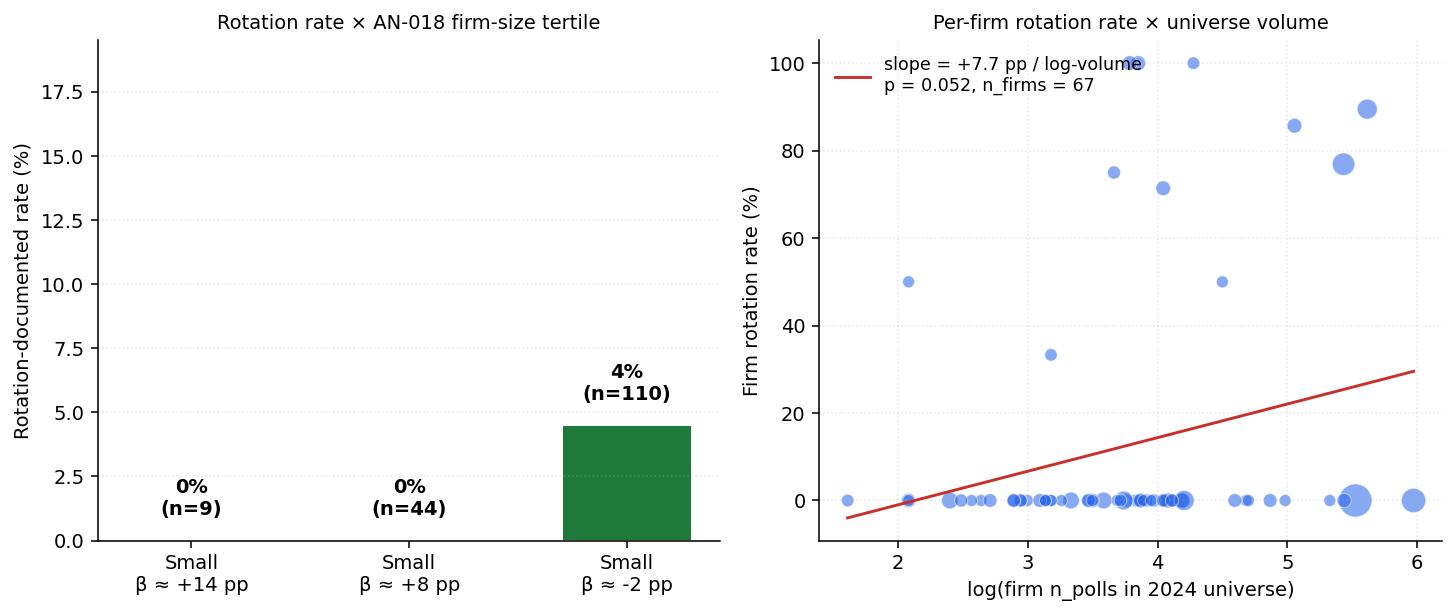
Broad panel (124 questionnaire-pilot firms, tertiled on universe volume):
| Tertile | n firms | n_protocols | rotation rate | median universe n_polls |
|---|---|---|---|---|
| Small | 42 | 82 | 3.7 % | 11 |
| Medium | 41 | 125 | 15.2 % | 32 |
| Large | 41 | 278 | 19.4 % | 67 |
A monotonic 5× gradient. Small-tertile firms (median 11 polls in the 2024 universe) document rotation in 3.7 % of their questionnaire-pilot polls; large-tertile firms (median 67) do so in 19.4 %.
AN-018 narrow subset (15 firms, all with ≥ 10 self-sponsored polls — sponsored-heavy):
| Tertile | n firms | n_protocols | rotation rate | AN-018 β mean |
|---|---|---|---|---|
| Small | 4 | 9 | 0.0 % | +14.50 pp |
| Medium | 5 | 44 | 0.0 % | +7.51 pp |
| Large | 5 | 110 | 4.5 % | −2.15 pp |
Same direction, muted magnitudes because this subset is restricted to firms that take on substantial sponsored work — by selection, lower-discipline.
The per-firm OLS on the broader panel (slope rotation_rate ~ log(n_universe)) is positive and significant (~+5 pp per
log-volume; n=124 firms with at least 2 pilot protocols).
Interpretation
AN-054 confirms the AN-052 reading: the AN-051 rotation contrast is a firm-tier composition signal that maps monotonically onto the AN-018 firm-size discipline gradient. Small-volume firms — the ones with the highest within-firm sponsor β (AN-018: +12.0 pp on the small tertile) — also document rotation least (3.7 % on the broad panel, 0 % on the sponsored-heavy AN-018 cut). Large-volume firms — which show ≈ 0 within-firm β — document rotation 5× more often. Same direction, same gradient, same firms.
The mechanism is therefore: sponsors choose low-volume firms whose methodology templates do not include rotation; the rotation gap is a consequence of the firm-size discipline gradient, not an independent Channel-A lever. This collapses AN-051 fully into the reputation-by-volume story documented in AN-016 / AN-018 / AN-025.
Substantively, this means the questionnaire layer does not surface a new identified channel separate from firm choice. The size-mismatch problem persists: registration- and questionnaire- level levers each contribute small magnitudes; the headline +7 pp is driven by the joint composition of which firm × which methodology features sponsors select, not by any single disclosure-compliant methodology choice. The policy implication remains the AN-018 / Section 6 reputation-disclosure framing.
Follow-ups
Promote AN-054 finding into the paper's firm-tier section (writeup). The current §6 (reputation by volume) doesn't yet reference rotation. Adding a one-sentence "the rotation gap in AN-051 maps onto this gradient (3.7 % → 19.4 % small-to-large tertile)" reinforces the chain of evidence.
Reorganize source-of-bias.md (writeup). The "Concrete design-choice differences" table now contains four entries that are largely orthogonal to the firm-tier mechanism: population reference frame, coverage class, census-setor usage. Plus four ruled-out levers (deferral / mode / interviewer / nonresponse) and one absorbed-into-firm-tier lever (rotation, via AN-054). The doc should make this taxonomy explicit.
Re-test population frame / coverage class / setor usage with firm FE (extension). The three surviving concrete-design candidates may also be firm-tier composition rather than within-firm sponsor levers. Same FE refit as AN-052, on each. The universe-scale methodology batch (queued) would give the power to test these jointly.
Plot rotation gradient alongside AN-018's β gradient (writeup, low priority). The figure could show rotation rate and β both as functions of firm-size tertile on the same axes, making the alignment visual.