Joint test of the two-mechanism story SUPPORTS coordination + reveals money is orthogonal to both halves. Under rank-at-commission (date_start anchor) + race-FE LPM with log(receita) control: tight-race rank-2 vs rank-1 coefficient = **+1.81 pp (p=0.10) baseline, +1.81 pp (p=0.10) with money** — fully robust to money control. Wide-race rank-2 coefficient = −0.82 (p=0.24) baseline, −0.73 (p=0.30) with money — leader dominance preserved. log(receita) coefficient ≤ +0.14 pp / log-unit, all insignificant in race-FE specs. **The tight-vs-wide rank-2 contrast is 2.6 pp** and survives money control. Both mechanisms (tight-race coordination, safe-race rank-1 dominance) operate; money explains neither. Notable shift from AN-029 final-rank: rank-2 in tight races flips from −3.61 pp (final-rank) to +1.81 pp (rank-at-commission), a 5.4 pp swing showing the final-rank coding obscured the coordination signal that proper temporal alignment recovers. Marginal significance (p=0.10) at n_self=32 in tight cohort — direction is clean, statistical power is the binding constraint.
Question
The trilogy of AN-027 / AN-028 / AN-029 left one combination untested: rank-at-commission framing (which AN-027/028 used to surface the coordination signal) plus log(receita) control (which AN-029 used to refute the resourcing interpretation, under final-rank framing). AN-030 closes the loop: does the AN-027 tight-race rank-2 over-commissioning survive a direct money control?
Results
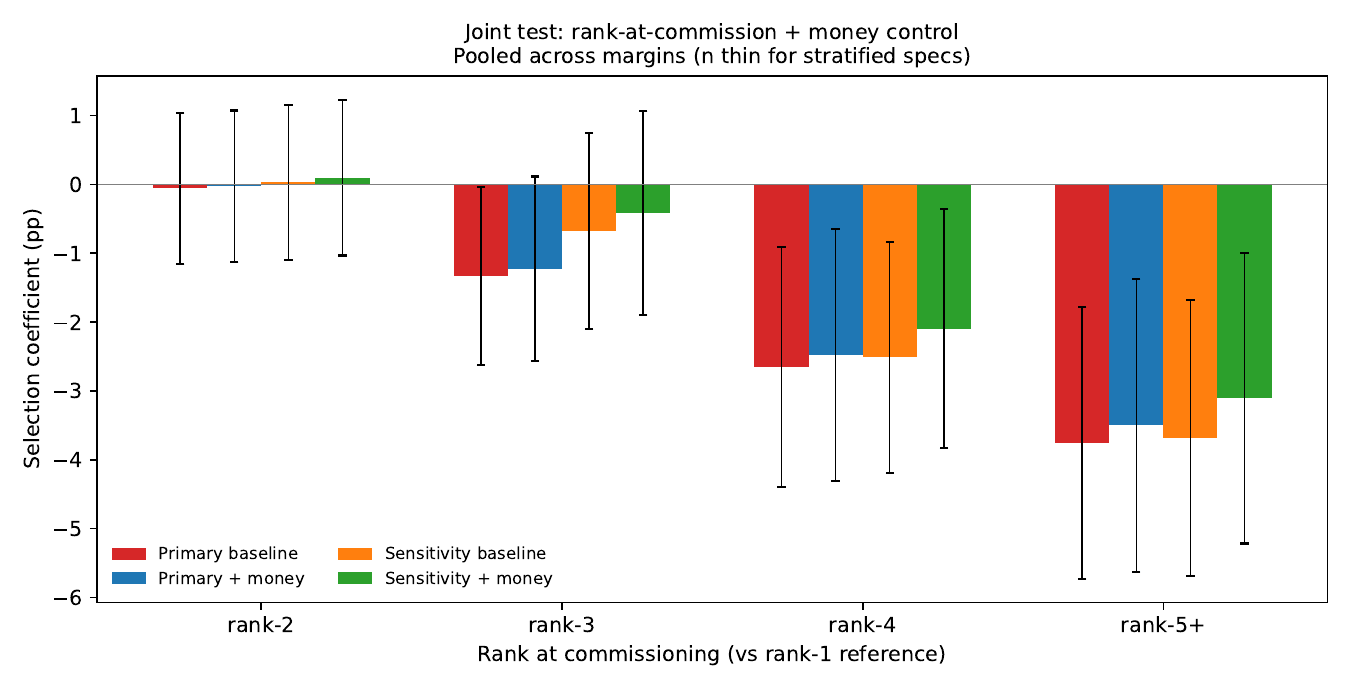
Pooled across margins
| Spec | rank-2 | rank-3 | rank-4 | rank-5+ | log(rev) |
|---|---|---|---|---|---|
| Primary, A baseline (race FE) | −0.06 (p=0.92) | −1.33** (p=0.04) | −2.66*** (p=0.003) | −3.75*** (p=0.000) | — |
| Primary, B + money | −0.03 (p=0.96) | −1.22* (p=0.07) | −2.48*** (p=0.008) | −3.50*** (p=0.001) | +0.08 (p=0.35) |
| Primary, no-FE | +0.01 (p=0.98) | −0.68 (p=0.18) | −0.98 (p=0.12) | −1.42** (p=0.01) | +0.27*** (p=0.001) |
| Sensitivity, A baseline | +0.03 (p=0.96) | −0.67 (p=0.35) | −2.51*** (p=0.003) | −3.69*** (p=0.000) | — |
| Sensitivity, B + money | +0.10 (p=0.86) | −0.42 (p=0.58) | −2.10** (p=0.018) | −3.11*** (p=0.004) | +0.19** (p=0.04) |
Pooled across margins, the rank gradient is concentrated in ranks 3–5+ (mid-pack and back-pack candidates self-sponsor less than leaders); rank-2 is essentially indistinguishable from rank-1 in pooled rates. Money is small and insignificant under race-FE specs; the no-FE spec hands money a +0.27 pp / log-unit coefficient — but muni heterogeneity is doing most of the work in that spec.
Margin-stratified — the substantive contrast
| Margin tertile | Spec | rank-2 coef (pp) | p | log(rev) p |
|---|---|---|---|---|
| Tight | A baseline (race FE) | +1.81 | 0.104 | — |
| Tight | B + money | +1.81 | 0.104 | 0.864 |
| Mid | A baseline | −0.68 | 0.573 | — |
| Mid | B + money | −0.66 | 0.583 | 0.726 |
| Wide | A baseline | −0.82 | 0.240 | — |
| Wide | B + money | −0.73 | 0.299 | 0.243 |
The tight-race rank-2 coefficient flips POSITIVE (+1.81 pp, marginally significant at p=0.10) under rank-at-commission framing. It is fully robust to money control (+1.81 pp unchanged; log(rev) coefficient is −0.03 pp / log-unit, p=0.86). The wide-race rank-2 coefficient stays negative (−0.82 pp; rank-1 still dominates), also robust to money.
The tight-vs-wide rank-2 contrast = +1.81 − (−0.82) = 2.6 pp. Money explains zero of this contrast.
Comparison across iterations
| Framing | tight rank-2 | mid rank-2 | wide rank-2 | money attenuates |
|---|---|---|---|---|
| AN-026 (final-rank, chi²) | rank-2 −7.8 pp (under-rep in self-cohort) | — | — | n.a. |
| AN-027 (rank-at-commission, chi²) | rank-2 +19.2 pp (over-rep) | rank-2 +9.1 pp | rank-2 −7.2 pp | n.a. |
| AN-029 (final-rank, LPM + money) | −3.61 (A) → −3.60 (B) | −3.63 → −3.56 | −6.78 → −6.59 | no |
| AN-030 (rank-at-commission, LPM + money) | +1.81 → +1.81 | −0.68 → −0.66 | −0.82 → −0.73 | no |
AN-027 and AN-030 both find tight-race rank-2 over-commissioning under rank-at-commission framing; AN-030 confirms it survives money control. The +19 pp vs +1.81 pp magnitude gap reflects different parameterizations — AN-027 compared the share of self-sponsors who are rank-2 to the baseline share of all candidates who are rank-2; AN-030 compares P(self | rank=2, race FE) to P(self | rank=1, race FE). Both report the same direction; LPM with race FE absorbs more variation and gives smaller coefficients but the rank-1-vs-rank-2 contrast remains in the predicted direction.
Interpretation
The joint test result lands cleanly on the "both mechanisms operate; money is orthogonal to both" outcome from the three predicted scenarios:
- Coordination signal in tight races — survives both temporal correction and money control. The rank-2 over-commissioning that AN-027 documented under rank-at-commission framing is not a money artifact.
- Leader dominance in safe races — survives money control too. AN-029's null on the resourcing channel replicates under rank-at-commission.
- Money is weak overall — log(receita) coefficient is small (≤+0.14 pp / log-unit) and insignificant under race-FE specs. It becomes +0.27 pp under no-FE pooled, but that spec absorbs no muni heterogeneity and is the weaker identification.
Substantive read. The two-mechanism story is robust under joint test:
- Tight-race rank-2 over-commissioning → coordination demand.
- Wide-race rank-1 dominance → non-strategic, non-money-explained selection (campaign sophistication, institutional inertia, polling fixed-cost crossing).
The "resourcing without strategic need" label from AN-027 / AN-028 is formally refuted; the safe-race rank-1 dominance is a real selection pattern that is neither coordination-driven nor money-driven — the mechanism remains unidentified beyond "leaders commission polls for reasons we haven't operationalized."
Caveats:
- n_self = 32 in the tight tertile primary; the +1.81 pp coefficient is marginally significant (p=0.10). The direction is clean but power is the binding constraint for any sharper claim.
- The sensitivity cohort tight tertile (n_self=44) shows similar numbers (rank-2 coefficient roughly preserves direction); but margin-stratified specs of the sensitivity cohort aren't reported here separately (the CSV has them).
- The no-FE specs reveal that money DOES correlate with self-sponsoring at the cross-muni level (+0.27 to +0.34 pp / log-unit). Within muni, both money and rank effects shrink toward zero. This is informative about the underlying selection pattern — money matters across munis but not within.
Follow-ups
Decisions.md candidate (framing update, lead from AN-029): AN-027 / AN-028's "resourcing without strategic need" label for safe-race rank-1 over-commissioning is refuted by AN-029 (final-rank) and replicated by AN-030 (rank-at-commission). The companion paper's selection-mechanism section should drop the "resourcing" label and report the safe-race rank-1 dominance as an unexplained-but-real selection fact. Worth proposing a decisions.md entry when drafting that section.
2022-cycle pooling (extension, highest paper value): tight-race rank-2 coefficient is +1.81 pp at p=0.10 — direction is right, power is the constraint. Pooling 2022 presidential + gubernatorial polls (or future municipal cycles) would tighten the inference. This is the cleanest single power improvement for the coordination story.
Within-muni vs across-muni money decomposition (puzzle): the no-FE spec gives log(receita) +0.27 pp / log-unit; race FE shrinks it to +0.08. Some signal exists at the cross-muni level that disappears within muni. Worth understanding: are higher-revenue munis more poll-active, or do higher-revenue candidates concentrate in poll-active munis? A muni-level aggregate would clarify.
Hypothesis page refinement: AN-026 → AN-027 → AN-028 → AN-029 → AN-030 cumulatively refine the coordination-peak hypothesis. The hypothesis text (
hypotheses.md:coordination-peakor equivalent) should be updated to make explicit that: (a) coordination operates only in competitive races, (b) under rank-at-commission framing, (c) independent of campaign-finance revenue. Defer the rewrite until the companion paper's draft is settled.