3-way sponsored × deferred × rank1 is NULL across all four specs (+2.03 / +4.09 / +0.46 / −12.51, SEs 3.3–10.5pp, sign-inconsistent). The AN-033 null does NOT hide leader-specific deferral amplification. Incidental finding: split-sample sponsored_by has a sharp rank gradient — +5.58pp (rank 1, p<0.01), +11.52pp (rank 2, p<0.001), −2.81pp (rank ≥3, null) — consistent with the AN-026/AN-027 coordination story but orthogonal to the deferral lever question.
Question
AN-033 found γ on sponsored × deferred ≈ 0 across all specs. That
null is on the pooled candidate sample. A natural concern: the
within-candidate average might hide a sharper rank-specific effect.
Leader polls have more room for coverage-style suppression — the leader's strength typically comes from broad reach across bairros, so a poll that restricts to favorable subareas can mechanically inflate their lead. A rank-1 sponsor pulling the deferred-coverage lever might amplify their bias more than a rank-3 sponsor doing the same. If so, the pooled γ averages an amplification effect for rank-1 with a null effect for trailing ranks, washing it out.
The 3-way sponsored × deferred × I(final_rank=1) is the rigorous
test. The split-sample sp × def within each rank bin is the
descriptive companion.
Design
Same analysis-table sample as AN-001 / AN-033 (n=27,907 candidate-poll
rows after dropping NaN error / muni). Same deterministic deferral
classifier from AN-024. final_rank from the analysis_table.
Specs (matched to AN-033 ladder):
- Spec 1 (pooled OLS): all 7 terms (sp, def, rank1, sp×def, sp×rank1, def×rank1, sp×def×rank1)
- Spec 2 (within-candidate FE): same, but rank1 main is absorbed
- Spec 3 (within-candidate + institute FE + methodology controls):
- institute FE, log(sample_size), days_to_election, days²
- Spec 4 (race × week FE, strict clean comparator): independent-poll comparator restriction + race × week FE
Plus descriptive companion: estimate the simple
error ~ sp + def + sp:def | candidate FE separately within
rank bins {1, 2, ≥3}.
Headline: 3-way coefficient on sp:def:rank1 in Spec 2 and Spec 3.
Results
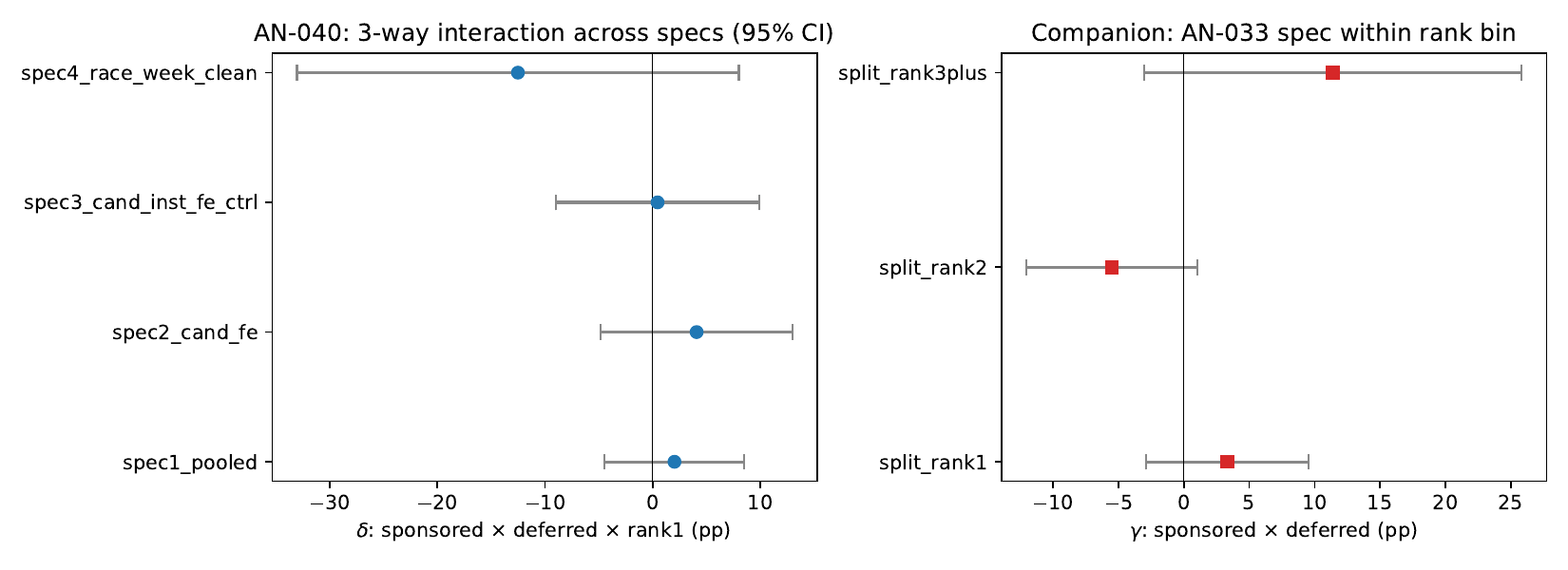
Table at build/table/an-040-deferral-rank-heterogeneity.csv.
Headline: 3-way interaction across specs
| Spec | sp×def×rank1 | sp×def | sp×rank1 | def×rank1 | sponsored_by | n |
|---|---|---|---|---|---|---|
| 1. pooled OLS | +2.03 (3.32) | −0.84 (2.43) | −3.19 (2.05) | −0.72 (0.60) | +10.18 (1.57) *** | 27,907 |
| 2. + candidate FE | +4.09 (4.53) | −0.96 (3.13) | −2.31 (3.25) | −0.74 (0.57) | +7.59 (2.69) ** | 27,907 |
| 3. + institute FE + controls | +0.46 (4.83) | +1.79 (3.65) | −1.12 (3.89) | −0.61 (0.70) | +6.50 (3.20) * | 27,907 |
| 4. race × week FE clean | −12.51 (10.48) | −0.76 (5.92) | +2.54 (8.91) | +0.71 (1.04) | +8.15 (4.98) | 19,576 |
Cluster-robust SE on muni_id in parentheses. *** = p<0.001, ** = p<0.01, * = p<0.05.
The 3-way sp × def × rank1 is null across all four specs —
sign-inconsistent and never close to significance. Rank-specific
deferral amplification is not in the data.
Split-sample companion: AN-033 spec within rank bin
| Rank bin | n | sponsored_by | deferred | sp × def |
|---|---|---|---|---|
| rank 1 (winners) | 8,416 | **+5.58 (1.86) ** | −0.87 (0.50) | +3.33 (3.18) |
| rank 2 (close losers) | 8,058 | **+11.52 (2.52) *** | −0.27 (0.50) | −5.51 (3.33) |
| rank ≥ 3 | 10,751 | −2.81 (7.19) | −0.13 (0.20) | +11.41 (7.36) |
The headline within-candidate sponsor bias coefficient has a sharp rank gradient that the +7pp pooled average obscures:
- Rank 2 candidates over-state by +11.5pp (close losers — exactly where the AN-026/AN-027 coordination demand is highest)
- Rank 1 winners over-state by +5.6pp (in line with the pooled average, smaller than rank 2)
- Rank 3+ stragglers don't over-state at all (−2.8pp, null) — noisy in the small sample but directionally absent
The sp × def cell coefficients are noisier (SEs 3.2–7.4pp) and bounce
in sign (+3.3 in rank 1, −5.5 in rank 2, +11.4 in rank 3+); none reach
significance individually. The pattern doesn't sharpen the deferral
lever specifically.
Interpretation
The headline test of the AN-033 follow-up hypothesis (leader-specific deferral amplification) is null — the 3-way interaction is small, sign-inconsistent, and underpowered across every spec ladder rung. Combined with AN-024 and AN-033, the conclusion on deferral is now tight: it is neither selected by sponsors (AN-024 wrong-signed at universe scale) nor amplified by them (AN-033 pooled null, AN-040 no rank heterogeneity).
The incidental rank gradient on the sponsored_by main effect is the more interesting result: rank 2 candidates over-state by twice as much as rank 1, and rank 3+ candidates don't over-state at all. This matches AN-026/AN-027's selection finding — runners-up at the viability cutoff have the highest coordination demand and the strongest incentive to inflate. But the headline-decomposition story this implies (sponsor bias is concentrated in close-loser polls) is orthogonal to the deferral question and is best chased as a companion analysis to AN-026/AN-027, not as a deferral lever.
Follow-ups
AN-NNN — sponsor-bias by final_rank × rank-at-commission (extension, highest follow-up paper value). The +11.5pp rank-2 sponsor effect (this analysis) and the +12-19pp rank-2 over-commissioning (AN-027) are pointing at the same population. A regression decomposing total observed bias as
error ~ sponsored × rank_at_commission × |race_margin|would localize the bias in the close-runner-up cell directly. Suggested script:source/analysis/an-NNN-sponsor-bias-by-rank.py.AN-NNN — same deferral heterogeneity on the surviving levers (extension, held under main forward task). Re-run the AN-040 3-way structure on
mixed_populationandurban_only_resolvedwhen those become universe-scale available. The deferral null ≠ the other-levers null; each needs its own rank-heterogeneity probe.AN-040 deferred × rank3+ small-cell puzzle (puzzle, low priority). The split-sample
sp × deffor rank 3+ candidates is +11.4pp (large but noisy, p=0.12). Worth a quick look at whether this is the result of a small handful of high-leverage rank3+ sponsored polls — could be a data-quality flag or could be a real but tiny effect.