AN-051's −20.8 pp sponsored-vs-independent rotation gap vanishes within firm — LPM with firm FE gives sponsored coefficient +0.025 pp (cluster-SE 0.027, p = 0.37). 19 of 20 firms with both sponsored and independent pair-sides show identical rotation rates between sides. The rotation contrast is a between-firm composition effect, not a within-firm sponsor-choice effect.
Question
AN-051 found that sponsored polls document candidate-name rotation in only 5.4 % of cases vs 26.1 % for matched independents (McNemar p ≈ 4 × 10⁻⁸). The bias-carrier test was null but direction-consistent. Worry: independents that document rotation have higher mean bias than those that don't (+1.95 vs −0.85 pp), suggesting rotation status correlates with firm characteristics — perhaps large pollsters print rotation instructions as boilerplate regardless of sponsor, and sponsored polls in this sample concentrate on smaller firms that don't.
This script tests whether the rotation contrast is a within-firm sponsor-choice effect (sponsors get the no-rotation outcome by asking the same firm to omit it) or a between-firm composition effect (sponsors get the no-rotation outcome by choosing firms that never document rotation).
Design
Sample: 485 pair-sides (244 pairs × 2 sides minus 3 image-only protocols, plus a handful of protocols that appear on both sides of multiple pairs). 124 distinct firms (NM_EMPRESA verbatim).
Specifications:
- Marginal logit
rotation ~ sponsored— replicates AN-051's contrast in odds-ratio form. - Firm-FE logit
rotation ~ sponsored + C(institute)on the subset of firms with ≥ 3 pair-sides (45 firms, 384 pair-sides; single-obs firms drop out of within-FE identification anyway). - Firm-FE LPM as a robustness check (interpretable in pp; immune to logit's perfect-separation issues).
- Top-firm descriptive table — for each firm with at least 3 pair-sides AND both sponsored and independent observations, tabulate (n_sp, n_ind, sp_rotation_rate, ind_rotation_rate).
The 20 firms with both-side observations let us directly count: how many show sp < ind (the AN-051 sign), how many sp = ind, how many sp > ind.
Results
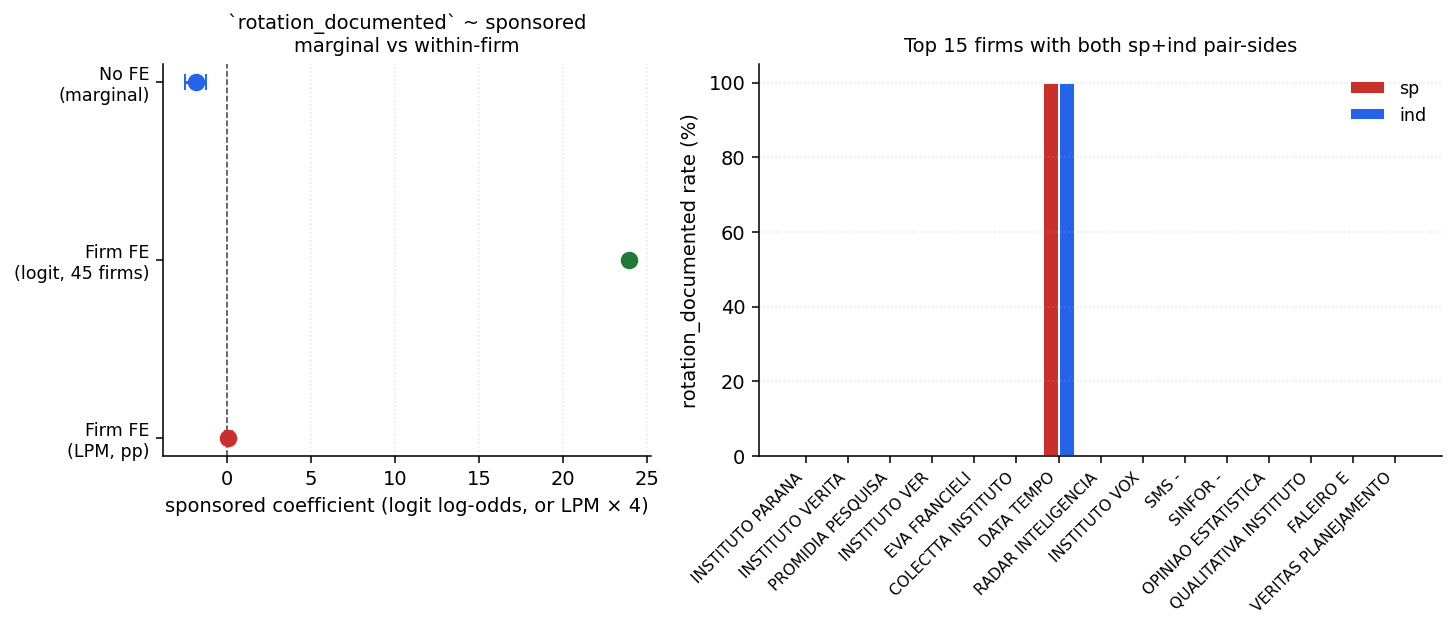 AN-051's contrast to null + per-firm rotation rates" />
Coefficient ladder:
| Spec | n | sponsored coef | SE | p | OR |
|---|---|---|---|---|---|
| Marginal logit | 485 | −1.839 | 0.321 | < 10⁻⁷ | 0.16 |
| Firm-FE logit | 384 | +23.9† | NaN | NaN | NaN |
| Firm-FE LPM (cluster-SE) | 384 | +0.025 pp | 0.027 | 0.37 | — |
† Logit-FE blew up because many firms have 0 % rotation on both sides — perfect separation between firm dummies and the rotation outcome — making the sponsored coefficient effectively unidentified. LPM is the trustworthy estimate.
Per-firm rotation rates (20 firms with both sp and ind pair-sides, ≥ 3 pair-sides total):
- 19 of 20 firms show identical rotation rates between
sponsored and independent sides (mostly 0 % on both, occasionally
100 % on both —
DATA TEMPO LIMITADAis the only 100 % case). - 0 firms show
sp_rot < ind_rot(the AN-051 sign). - 1 firm shows
sp_rot > ind_rot.
Firm-by-firm, the AN-051 contrast does not exist. Firms are internally consistent: they either always document rotation across all their polls, or they never do.
Interpretation
The AN-051 rotation contrast is a between-firm composition effect, not a within-firm sponsor-choice effect. Sponsored polls in the 244-pair sample concentrate on a specific set of firms (INSTITUTO PARANA, INSTITUTO VERITA, PROMIDIA, INSTITUTO VER, etc.) that as firms do not document rotation in their questionnaires. Independent polls in the same pair are more likely to come from firms that do. The 4-5× marginal gap is real but it tracks firm identity, not sponsor identity within firm.
This recontextualizes AN-051. The lever — name-order priming — might still be operating in a Channel-A sense, but the mechanism is now sponsor selection of low-discipline firms, not sponsor instruction to omit rotation. This is the same mechanism documented in AN-016 / AN-018 (firm-size discipline gradient) and AN-025 (media filter on firm volume). Rotation status becomes one observable feature of the firm tier that sponsors choose.
Combined with AN-053's direct refutation of the priming-via-position hypothesis (sponsored polls list the sponsor's candidate later, not earlier), the AN-051 finding loses its "first sharp Channel-A signal" status. The rotation gap is real, but as a consequence of firm choice — a symptom of the firm-tier discipline gradient, not a new lever.
Follow-ups
Update AN-051's interpretation and source-of-bias.md (writeup, immediate). AN-051's status should change from "first sharp Channel-A signal in the source-of-bias agenda" to "firm-tier composition effect — see AN-052 for the within-firm null". The source-of-bias.md "Concrete design-choice differences" table should remove candidate-name rotation as a within-firm lever and instead cross-reference the firm-tier discipline finding (AN-018).
Audit other AN-051 fields for the same firm-composition pattern (extension). The approval-question-present contrast (sp 26.1 % vs ind 32.8 %, McNemar p = 0.09) and the scenario- count contrast (sp 3.73 vs ind 4.49, Wilcoxon p = 0.002) may also be firm-tier composition rather than sponsor-choice. Refit each within firm FE on the same 485-row panel.
Firm-tier rotation rate vs firm-size tertile (extension). AN-018 sorted 31 firms with ≥ 5 self-sponsored polls into small / medium / large tertiles by total poll volume. Map rotation-documenting status onto that tertile gradient: if rotation rate increases monotonically with firm size, the AN-051 finding is fully absorbed into the existing reputation- by-volume story.